
Intelligent Infrastructure
AI-supervised data pipelines
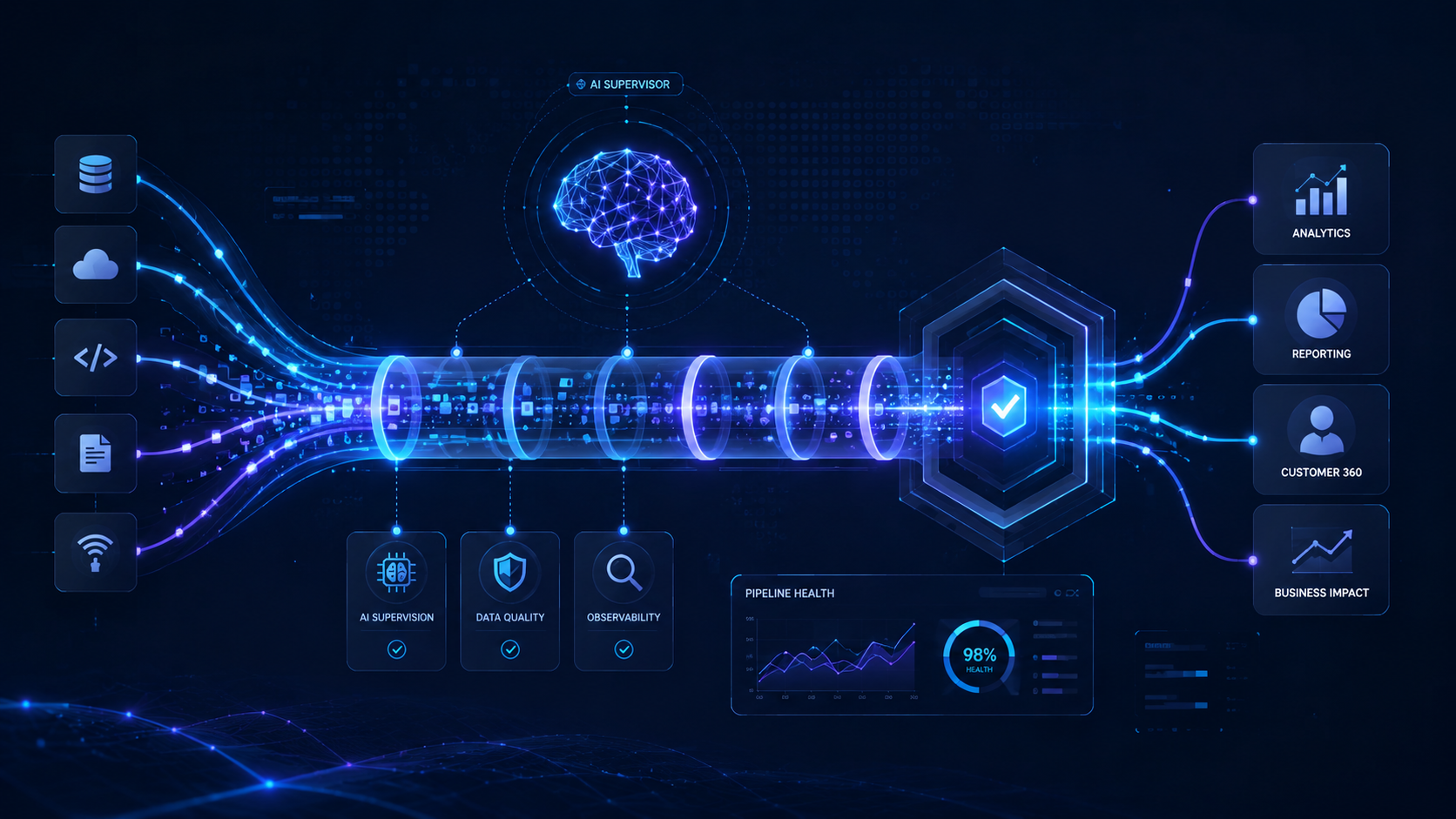
Data pipelines should not only move information from one system to another. They should help teams understand whether data is complete, accurate, fresh, consistent, and still aligned with business reality.
Core idea
For years, data engineering focused on ingestion, transformation, orchestration, and delivery. The goal was to extract data from source systems, transform it into a usable format, and make it available in a warehouse, lakehouse, dashboard, application, or machine learning model.
That is no longer enough. Business systems change every day. CRM fields are renamed. ERP structures evolve. Marketing campaigns introduce new values. APIs return unexpected formats. Product teams modify event tracking. Finance rules are adjusted.
A pipeline can still run successfully from a technical perspective while the data is no longer trustworthy.
The Problem With Traditional Data Pipelines
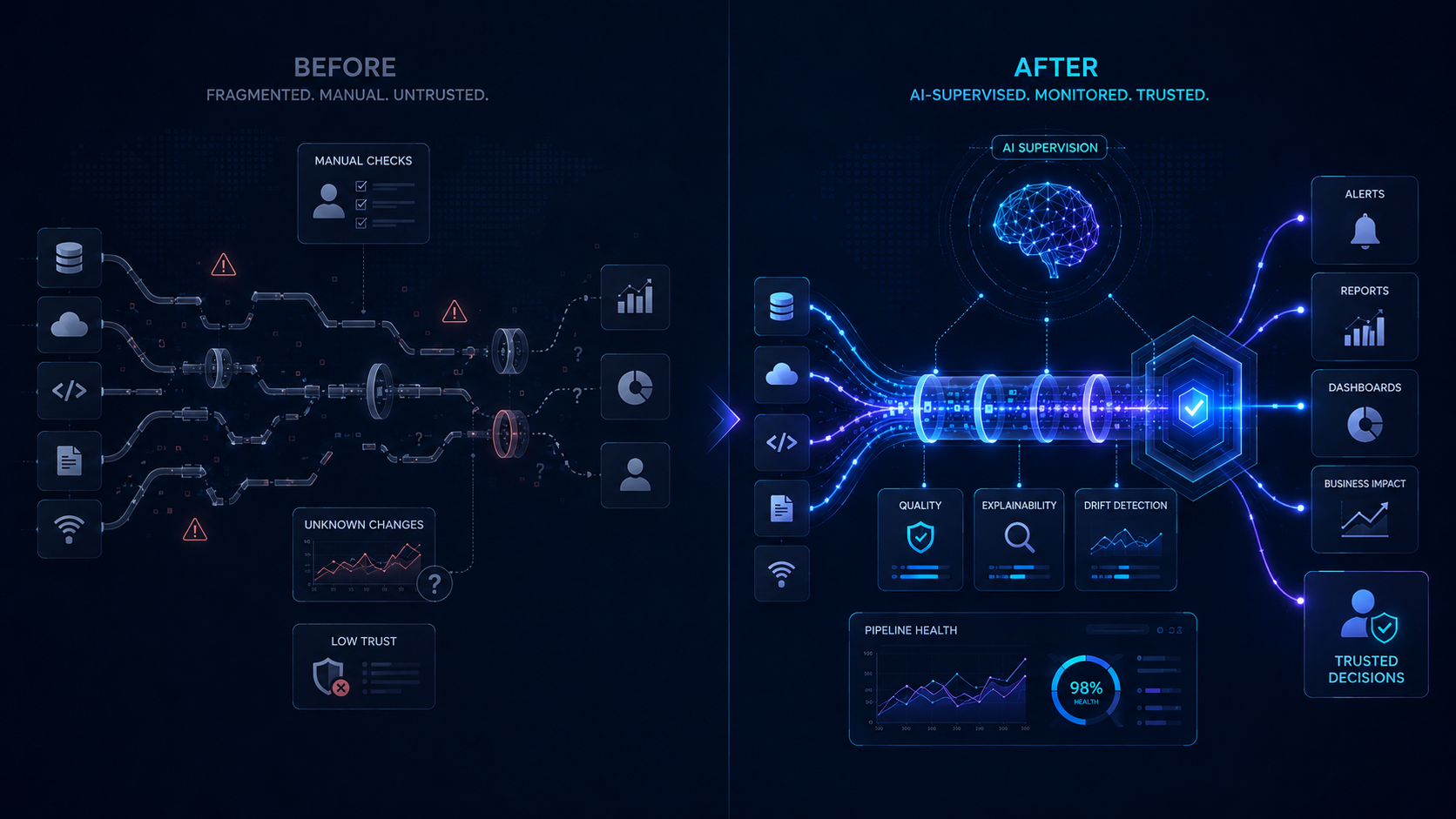
Traditional data pipelines are usually designed around execution.
They answer questions like: did the job run, did the file arrive, did the table load, did the API respond, and did the dashboard refresh? These questions are important, but they are not sufficient.
A successful job can still produce bad data. That creates a dangerous gap between technical success and business trust.
A CRM pipeline loads all records, but 30% of new opportunities have no owner.
A finance job runs without error, but revenue is duplicated because of a join issue.
A marketing dashboard refreshes on time, but new campaign names break reporting categories.
A warehouse table is loaded, but the number of rows is 70% lower than usual.
A machine learning feature pipeline runs, but the input distribution has drifted.
A sales dashboard updates, but conversion logic is wrong because a stage was renamed.
Why Pipelines Need Supervision
Modern organizations depend on data for decisions, automation, reporting, forecasting, compliance, customer experience, and AI systems. When data changes unexpectedly, the impact can be significant.
Wrong business decisions
Misleading dashboards
Incorrect forecasts
Broken operational workflows
Poor customer segmentation
Compliance exposure
Expensive manual investigations
Lower AI model reliability
The problem is not only that data issues happen. The real problem is that teams often discover them too late, usually when a business user says, "This number looks wrong."
AI-supervised data pipelines create a supervision layer between technical execution and business consumption so issues are detected, explained, and routed earlier.
What Is an AI-Supervised Data Pipeline?
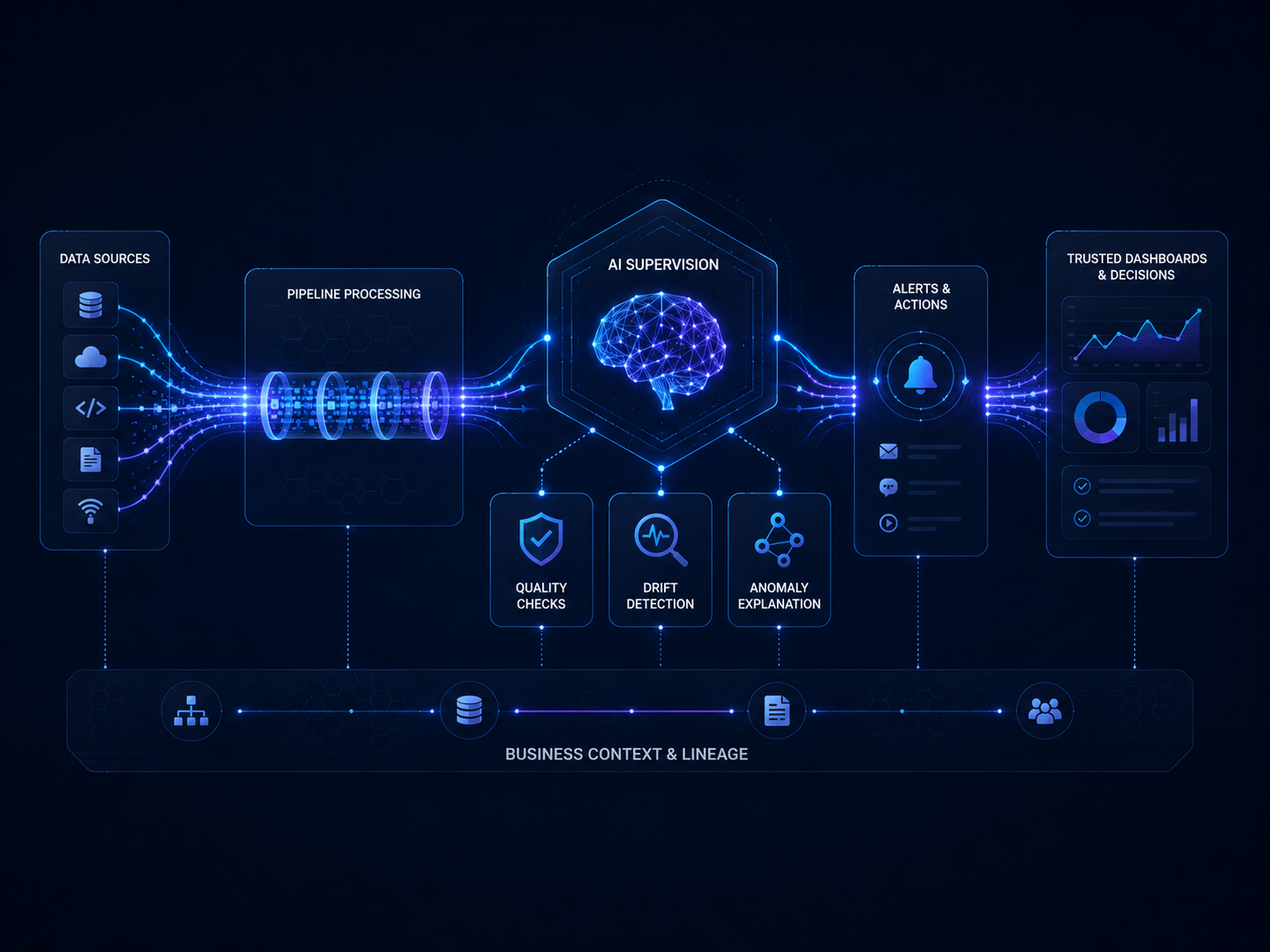
An AI-supervised data pipeline is a pipeline enhanced with intelligent monitoring, automated checks, anomaly detection, drift analysis, contextual explanation, and assisted remediation.
It does not replace traditional data engineering. It extends it.
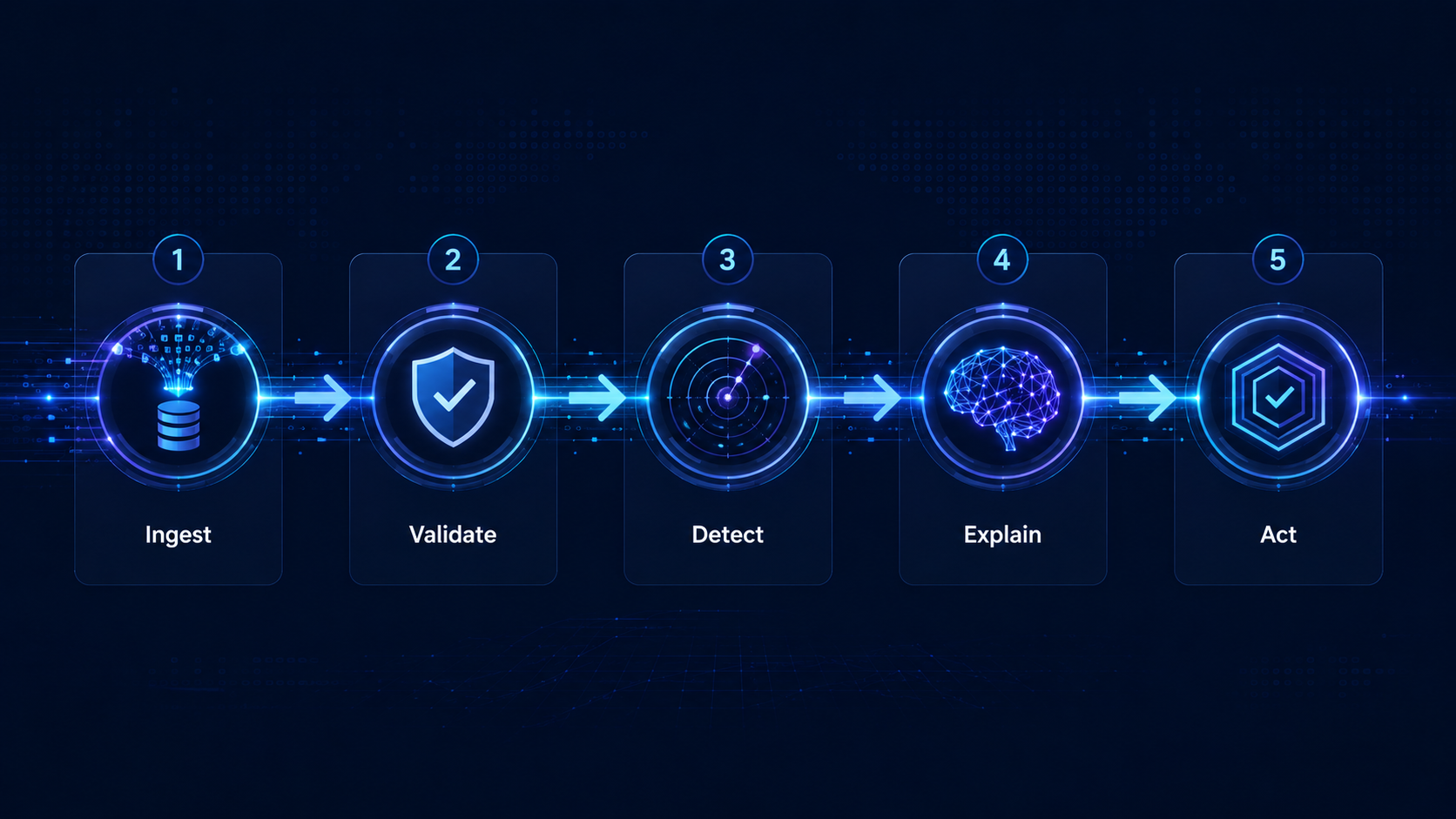
A traditional pipeline moves and transforms data. An AI-supervised pipeline also observes, evaluates, explains, and recommends. The goal is not a fully autonomous black box. The goal is better visibility, faster diagnosis, and stronger control.
Is the data complete, fresh, valid, and consistent?
Has schema or field meaning changed?
Are values drifting compared with normal behavior?
Which downstream reports, models, or teams are affected?
What is the likely root cause?
What should the data owner do next?
Core capabilities
What AI Supervision Adds to the Pipeline
An AI-supervised pipeline combines several capabilities that work together.
Data quality monitoring
Continuously checks completeness, uniqueness, validity, referential integrity, freshness, and business rules.
Anomaly detection
Learns normal behavior across volumes, null rates, latency, distributions, and metrics so unusual changes are visible early.
Drift detection
Detects when customer behavior, product mix, feature distributions, or business metrics move away from historical patterns.
Schema change detection
Monitors technical structure and semantic meaning when fields, types, formats, payloads, or enum values change.
Business rule monitoring
Turns expectations from business teams into automated controls that protect reports, operations, finance, and AI.
Plain-language explanation
Summarizes what changed, where it happened, why it matters, and which action should be taken next.
Data Quality Monitoring
Data quality monitoring continuously checks whether data respects expected technical and business rules. These checks are not new, but AI supervision makes them more adaptive, contextual, and easier to operate.
Required fields are not null.
IDs remain unique.
Amounts are positive.
Dates are valid.
Status values belong to an accepted list.
Duplicates stay below a defined threshold.
Freshness respects business expectations.
Volumes remain within expected ranges.
Instead of relying only on manually written rules, AI can identify patterns, suggest new controls, detect suspicious changes, and prioritize the issues that matter most.
Anomaly Detection
A pipeline should detect unusual behavior automatically. Traditional monitoring often uses fixed thresholds such as "alert if row count is below 10,000." Fixed thresholds are useful, but they do not always capture seasonality, weekends, holidays, campaigns, business cycles, or growth.
A sudden drop in row count
A new category in a dimension
A spike in failed records
A delay in data arrival
A change in value distribution
A metric change without a known business reason
AI-based anomaly detection can learn normal behavior over time and identify deviations that deserve attention. It can understand that Monday sales volume is different from Saturday sales volume, or that month-end finance data behaves differently from mid-month data.
Data Drift Detection
Data drift happens when the statistical behavior of data changes over time. It is especially important for analytics, reporting, and AI systems.
Customer segments may change. Product categories may shift. Lead sources may evolve. Sales cycle duration may increase. Payment methods may change. Support ticket categories may drift.
Drift does not always mean data is wrong. Sometimes it reflects a real business change. The supervision layer should help answer what changed, where, when, how much, and why it matters.
Schema Change Detection
Schema changes are one of the most common causes of pipeline failures. A source may add a column, remove a column, rename a field, change a data type, modify a date format, change nested API payloads, or introduce new enum values.
Some schema changes break pipelines immediately. Others are more dangerous because the pipeline keeps running while the meaning of the data changes silently.
Technical schema
Column names, data types, nested structures, date formats, payload shape, and required fields.
Semantic schema
Field meaning, accepted values, business usage, metric logic, and downstream interpretation.
Business Rule Monitoring
Data quality is not only technical. Many issues come from broken business rules that are known by business teams but not encoded in pipelines.
A closed opportunity must have a close date.
A paid invoice must have a payment date.
A transaction must be linked to a valid account.
A lead marked as qualified must have a source.
A customer must belong to one active segment.
A support ticket cannot be resolved before it is created.
AI supervision can help document, suggest, classify, and monitor business rules across datasets. It can also help translate business expectations into reusable technical controls.
Layer-by-Layer Supervision
A complete AI-supervised pipeline usually supervises every layer of the data chain.
Ingestion
Collects data from CRM, ERP, SaaS tools, APIs, files, event streams, logs, and third-party providers.
Transformation
Cleans, joins, enriches, aggregates, maps, and reshapes data into reusable business datasets.
Storage
Stores governed data in warehouses, lakehouses, marts, databases, and analytical platforms.
Consumption
Feeds dashboards, reports, APIs, operational apps, automations, and machine learning systems.
The Role of Metadata and Lineage
AI-supervised pipelines depend heavily on metadata. Metadata is data about data. Without it, AI supervision has limited context. With it, the system can understand relationships.
Table and column names
Data types and owners
Business definitions
Transformation logic
Pipeline execution history
Quality test results
Lineage graph
Dashboard dependencies
Metric definitions
Incident history
Lineage shows how data moves and transforms across systems. It answers where a field came from, which pipeline transformed it, which table depends on it, which dashboard uses it, and which upstream source caused an issue.
Metadata turns isolated alerts into explainable incidents. Lineage turns those incidents into an impact map.
Explaining Anomalies in Plain Language
Technical alerts are useful for engineers, but they are not always enough for business users. A raw alert may say that the null percentage in crm_opportunity.next_step increased from 8.4% to 37.9%.
An AI-supervised system should explain that a higher-than-usual number of sales opportunities are missing next steps, that the issue mainly affects opportunities created in the last 48 hours by the EMEA sales team, and that forecast accuracy may be impacted because next step is used to assess pipeline health.
The goal is not only to detect problems. The goal is to make them understandable.
AI Agents for Pipeline Supervision
AI agents can observe data, reason about context, take limited actions, and recommend actions based on defined permissions. In pipeline supervision, agents can reduce manual investigation work.
Monitor execution and quality failures
Compare anomalies with historical incidents
Search documentation and lineage
Summarize business impact
Create incident tickets
Draft stakeholder explanations
Suggest remediation steps
Recommend new quality rules
An agent could detect a sudden volume drop, check recent deployments, compare the anomaly with historical patterns, identify affected dashboards, and generate a short incident summary. It should operate within clear governance rules, with critical decisions reserved for humans.
Common Use Cases
AI-supervised pipelines are useful wherever business decisions depend on reliable data.
RevOps and CRM data
Monitor missing owners, invalid stages, duplicate accounts, incomplete lead sources, territory issues, and forecast data quality.
Finance pipelines
Detect duplicate transactions, missing invoices, currency issues, mapping errors, late arrivals, and period-close completeness risks.
Marketing analytics
Catch UTM gaps, campaign naming changes, attribution anomalies, traffic drops, cost data issues, and platform API changes.
Product analytics
Supervise event volume, payload schema, unexpected properties, funnel changes, release impact, and feature usage drift.
Machine learning pipelines
Watch feature drift, label drift, training-serving skew, missing values, class balance, freshness, and prediction changes.
Example: AI-supervised CRM pipeline
Basic alert
Opportunities without a next step increased from 7% to 41% in two days.
Supervised explanation
The issue mainly affects enterprise opportunities in EMEA. The change started after the CRM workflow update deployed on Monday and may affect the weekly pipeline review dashboard and forecast quality.
Example: AI-supervised finance pipeline
Basic alert
Revenue anomaly detected for Morocco.
Supervised explanation
Revenue is 35% lower than the expected range. Order volume is stable, but the issue appears after invoice transformation because many invoices were assigned to an unknown revenue category.
From Reactive Alerts to Proactive Trust
Many data teams operate reactively. They wait for a pipeline failure, dashboard complaint, or business escalation. AI-supervised pipelines support a more proactive model.
Instead of waiting for users to find problems, the system continuously evaluates data reliability. The team moves from "we fix data problems when someone reports them" to "we detect, explain, and prevent data issues before they affect decisions."
This improves trust, reduces firefighting, and helps data teams become strategic partners to the business.
Building the Architecture
A strong AI-supervised pipeline architecture includes several connected components.
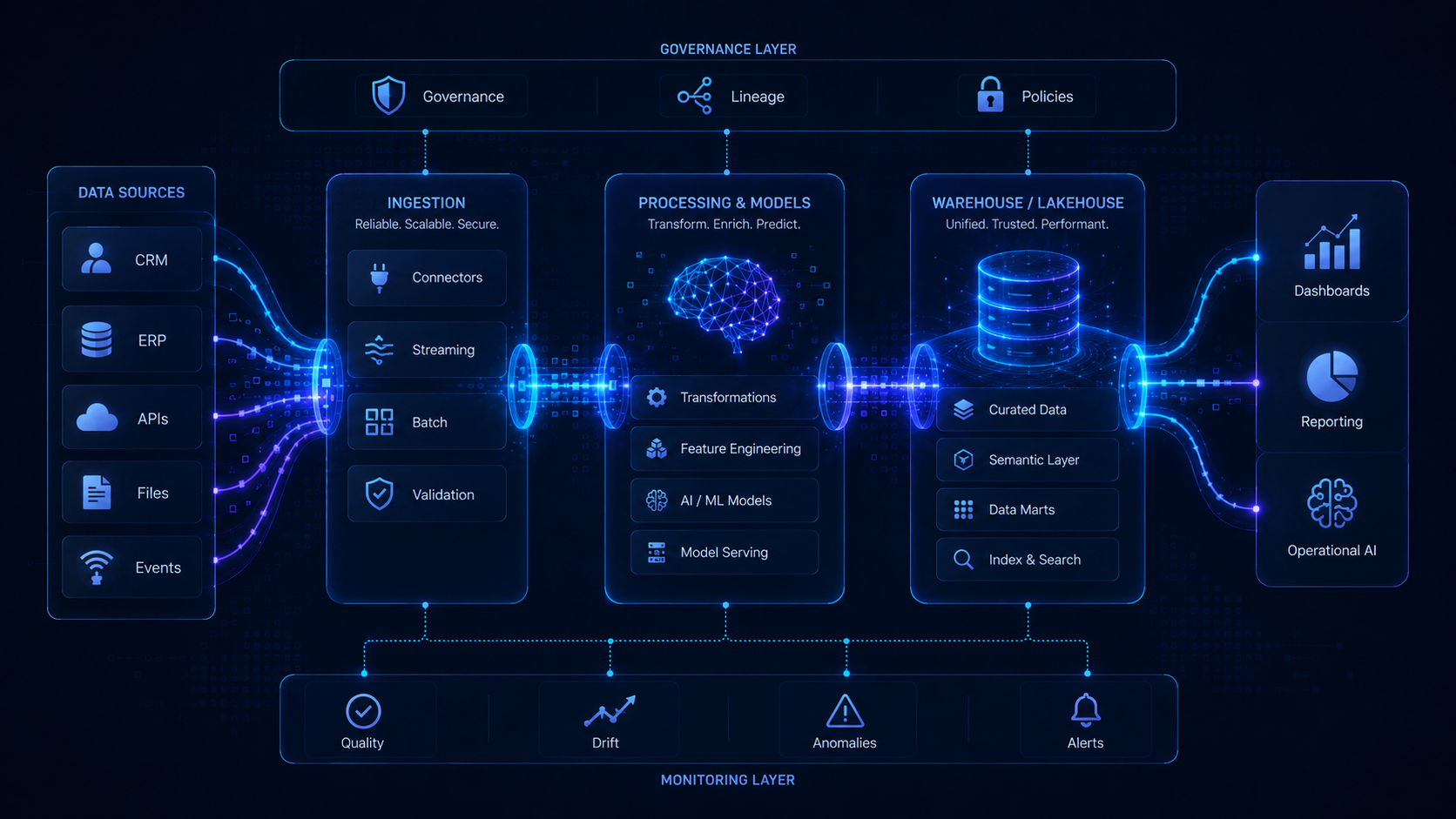
Orchestration
Data quality framework
Observability layer
Metadata and lineage repository
AI supervision engine
Notification and workflow layer
Detection alone is not enough. The system must connect to Slack, Microsoft Teams, Jira, ServiceNow, email, data catalogs, incident platforms, or dashboard warnings so the right people receive the right information at the right time.
Best Practices for Implementation
Organizations can implement AI-supervised pipelines effectively by starting focused and improving iteratively.
Start with critical data products
Prioritize executive dashboards, revenue reporting, finance, operational KPIs, AI features, and regulatory reports.
Define business expectations
Document freshness, volume, required fields, accepted values, business rules, owners, and escalation paths.
Combine rules and learning
Use rules for known constraints and AI or statistical methods for drift, anomalies, grouping, and explanations.
Build feedback loops
Let users mark alerts as valid, expected, false positive, low priority, or critical so supervision improves over time.
Connect alerts to workflows
Every incident should have severity, owner, business impact, suggested action, status, history, and resolution.
Create two explanations
Technical teams need diagnostics. Business teams need impact, trust status, affected KPIs, and next action.
Challenges and Risks
AI supervision is powerful, but it must be designed carefully.
False positives
Campaigns, holidays, and business cycles can create legitimate spikes. Feedback and context reduce alert noise.
Lack of context
AI without business calendars, metadata, ownership, and known events can misread expected changes.
Poor ownership
If no one owns a dataset, even good alerts fail to become action.
Over-automation
High-impact data changes, financial logic, and production corrections should require human validation.
Explainability
A black-box anomaly score is not enough. Teams need evidence, comparisons, confidence, and impact.
Metrics to Track
The success of AI-supervised pipelines should be measured by trust, speed, and operational impact, not only by technical uptime.
Incidents detected before business users report them
Mean time to detection
Mean time to resolution
False positive rate
Percentage of critical datasets monitored
Data freshness compliance
Quality rule failure rate
Downstream assets affected
Reduction in manual investigation time
Number of prevented reporting issues
The Future of Data Pipelines
The future of data pipelines is not only automation. It is supervision.
Pipelines will increasingly become intelligent systems that observe themselves, understand normal behavior, detect abnormal changes, explain business impact, recommend corrective actions, learn from feedback, collaborate with data owners, and protect downstream decisions.
This is especially important as companies adopt more AI. AI systems are only as reliable as the data that feeds them. If pipelines are blind, AI systems become fragile. If pipelines are supervised, AI systems become safer, more reliable, and easier to govern.
Conclusion
From Moving Data to Understanding Data Change
Data pipelines should not only move information. They should help organizations understand whether data can be trusted.
In a modern business, source systems evolve, business rules shift, schemas change, and user behavior drifts. A pipeline that only checks whether a job succeeded is not enough.
AI-supervised data pipelines monitor quality, detect drift, explain anomalies, identify affected assets, and help teams understand when something has changed. They reduce manual investigation, improve trust, strengthen governance, and protect business decisions.
The strongest data operating systems will not only move data. They will observe, explain, and protect it.
Next step
Identify where your pipelines need supervision.
A focused data audit can reveal the pipeline checks, metadata, lineage, ownership, and AI supervision patterns that matter most for your business.
Book a data audit