
Data Diagnostic

By Mohamed KHEY
February 12, 2026
What makes business data hard to trust
Business data should clarify what is happening, reveal risks, show opportunities, and guide action. Yet in many organizations, it creates doubt, debate, and slower decisions.

The problem is rarely only technical. Of course, data pipelines can fail. Systems can be badly integrated. Dashboards can contain errors. But the deeper issue is usually organizational.
Business data becomes hard to trust when ownership is unclear, definitions are inconsistent, processes are fragmented, and governance is treated as a documentation exercise rather than an operational discipline.
When business users no longer trust the numbers, every decision becomes heavier. Teams start questioning reports instead of acting on them. Meetings turn into reconciliation sessions. Different departments defend their own version of the truth. Leaders lose confidence in dashboards. Data teams become overloaded with urgent fixes.
Trust in data is not built by technology alone. It is built through consistency, transparency, accountability, and control.
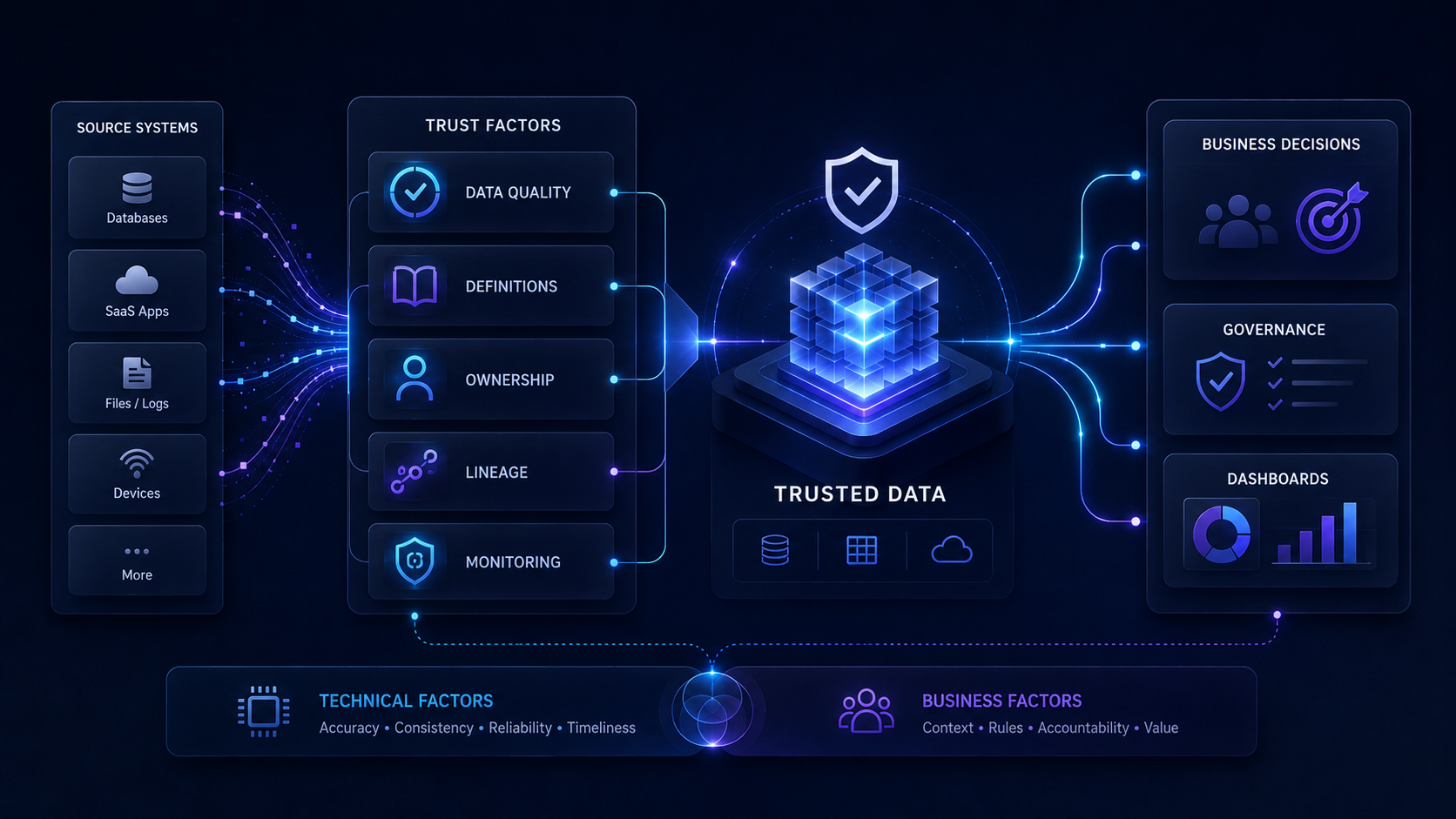
Definition drift
The same words are used differently by sales, finance, support, marketing, and operations.
Quality doubt
Small visible errors make teams question the reliability of the whole reporting ecosystem.
Black-box data
Users see final numbers but cannot trace source systems, transformations, rules, or refresh status.
Accountability gap
Business, data, IT, and governance teams all touch the data, but ownership is not explicit enough.
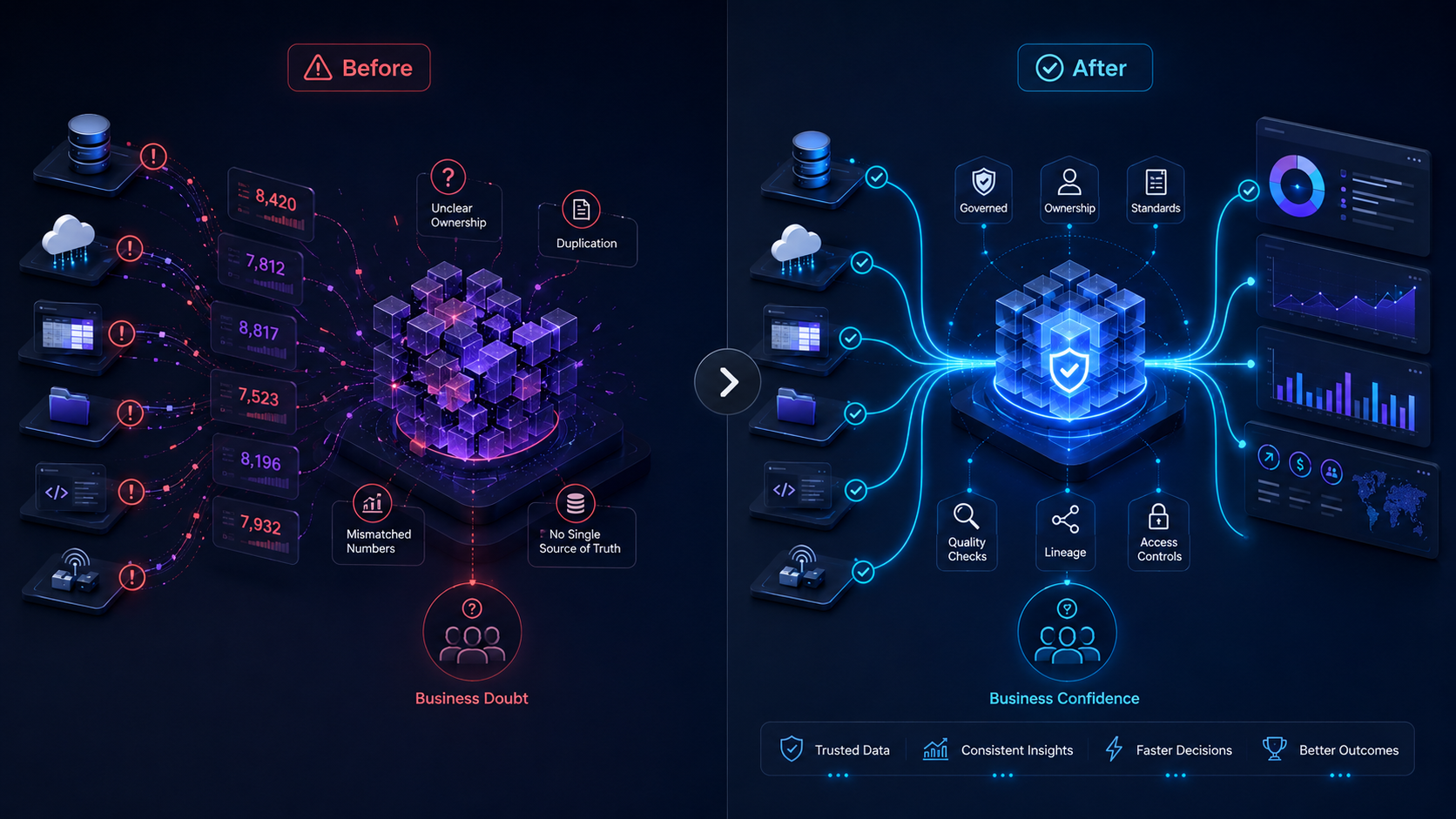
The mistrust pattern
Data trust breaks when business meaning, technical flow, and accountability drift apart.
The symptoms appear in dashboards, but the causes usually live across systems, workflows, teams, ownership models, and governance routines.
Business meaning
Definitions, rules, entities, statuses, KPIs, and reference data must mean the same thing across teams.
Technical flow
Pipelines, transformations, freshness, lineage, quality checks, and integrations must be observable.
Accountability
Owners, stewards, data teams, governance teams, and users need clear decision rights and escalation paths.
Shared language
Data becomes hard to trust when definitions are not shared
One of the most common causes of mistrust is simple: different teams use the same words to mean different things.
A customer may mean one thing for Sales, another for Finance, another for Support, and another for Marketing. Revenue may be calculated differently depending on whether the team looks at invoiced revenue, booked revenue, recurring revenue, recognized revenue, or collected revenue. A qualified lead may vary between CRM fields, marketing automation platforms, and sales pipeline reports.
At first, these differences may look harmless. Each department adapts definitions to its own needs. Over time, however, these variations create serious confusion.
A leadership meeting may start with a simple question: how many active customers do we have? Instead of one answer, the company gets several numbers. Sales has one number. Finance has another. Customer Success has a third. The data team may provide yet another number from the warehouse.
The issue is not that one team is necessarily wrong. The issue is that the business has not agreed on a controlled definition.
Trusted data requires a common business language. Key concepts must be clearly defined, documented, governed, and implemented consistently across systems and reports.
Quality controls
Data quality issues create silent doubt
Data quality problems are often invisible at first. A missing field, duplicate record, outdated status, invalid date, wrong category, or inconsistent naming convention may not immediately break a dashboard. The report still loads. The chart still displays. The KPI still appears.
But users start noticing small inconsistencies. A client appears twice in the CRM. A supplier name is written in three different ways. A product is assigned to the wrong category. A region is missing from a sales report. A closed opportunity still appears as open. A dashboard total does not match an exported spreadsheet.
Each individual issue may seem minor. Together, they create doubt.
Once users find one error, they begin to question everything else. They wonder whether the dashboard is reliable, whether the pipeline is complete, whether the numbers can be trusted, and whether the business is making decisions on inaccurate information.
Trusted data requires continuous quality controls. These controls should check completeness, validity, uniqueness, consistency, freshness, and business rule compliance. More importantly, they should be visible to the business, not hidden inside technical logs.
Traceability
Data lineage is often missing
Business users often see the final number but do not know where it comes from.
A KPI appears in a dashboard. But which source system produced it? Which transformations were applied? Which filters were used? Which business rules were implemented? When was the data last refreshed? Who validated the logic?
Without lineage, data becomes a black box. Users may see a number, but they cannot understand its origin. Data teams may struggle to investigate issues because they need to manually trace the path from source systems to pipelines, tables, semantic layers, and dashboards.
This becomes especially problematic in complex environments where data moves through multiple systems: CRM, ERP, billing platforms, data lakes, data warehouses, transformation tools, BI platforms, spreadsheets, and manual uploads.
Trusted data requires clear lineage from source to consumption. The organization should be able to answer where the data comes from, how it was transformed, who owns it, and where it is used.
Accountability
Ownership is often unclear
Data cannot be trusted if nobody clearly owns it.
In many companies, data ownership is vague. Business teams assume the data team is responsible because the data appears in dashboards. Data teams assume business teams are responsible because they understand the meaning of the data. IT teams may manage the systems but not the business rules. Governance teams may define policies but not control daily execution.
When a field is missing, who must fix it? When a business rule is unclear, who decides? When duplicate records appear, who is accountable? When a KPI definition changes, who approves the change? When a dashboard is wrong, who validates the correction?
Data ownership does not mean that one person manually fixes everything. It means there is clear accountability for definitions, rules, quality expectations, validation, and escalation.
Without ownership, data quality becomes everyone's concern but nobody's responsibility.
Manual workarounds
Manual processes introduce risk
Many business data problems come from manual workarounds.
Spreadsheets are exported, modified, re-uploaded, copied, merged, and shared by email. Business rules are applied manually. Reference data is maintained in local files. Exceptions are handled outside official systems. Reports are adjusted before presentations. Teams create their own versions of datasets because the official ones are too slow, incomplete, or hard to use.
Manual processes are sometimes necessary, especially in fast-moving environments. But when they become part of critical reporting, they create risk.
Manual work introduces errors, delays, and lack of traceability. It also makes governance difficult because the real business logic lives outside controlled systems.
Trusted data requires reducing manual intervention where possible and controlling it where it cannot be avoided. Manual inputs should be tracked, validated, versioned, and documented.
Integration
Systems are often disconnected
Modern businesses use many specialized tools: CRM, ERP, HR systems, billing platforms, marketing tools, customer support systems, logistics tools, finance software, and analytics platforms.
Each system captures part of the truth. But business decisions usually require a consolidated view.
Understanding customer profitability may require data from sales, contracts, billing, support, product usage, and finance. Understanding operational performance may require data from logistics, workforce planning, suppliers, assets, incidents, and cost centers.
When systems are disconnected, teams build partial views. Each department trusts its own system but questions others. Integration becomes fragile. Data reconciliation becomes a recurring activity.
Trusted data requires more than dashboards. It requires a coherent data architecture that aligns systems, identifiers, business rules, ownership, and reporting layers.
Master data
Reference data is poorly governed
Reference data is often underestimated.
Lists of countries, currencies, cost centers, departments, products, business units, suppliers, locations, categories, channels, statuses, and codes may seem simple. But they are essential for reporting and decision-making.
If reference data is inconsistent, reports become inconsistent. A region may be named North Africa in one system, NAF in another, and Africa North in a third. A product category may change without being reflected in historical reports. A supplier may be created twice because naming conventions are not controlled.
Reference data is the backbone of analytics. If it is not governed, even advanced data platforms become unreliable.
Trusted data requires controlled reference data management: ownership, validation workflows, naming standards, versioning, approval processes, and synchronization across systems.
Freshness
Data freshness is not always visible
A dashboard may look modern and reliable, but if users do not know when the data was last updated, they may not trust it.
Some business decisions require near real-time data. Others can rely on daily, weekly, or monthly updates. The problem appears when users do not know the expected refresh frequency or whether the latest refresh succeeded.
A sales dashboard may show yesterday's pipeline while users assume it is live. A finance report may contain last month's closing data but not recent adjustments. An operational dashboard may miss delayed files from source systems.
When freshness is unclear, people start double-checking manually. They export data from source systems, ask colleagues for confirmation, or avoid using the dashboard altogether.
Trusted data requires visible freshness indicators. Users should know when data was last updated, whether the refresh succeeded, whether source files were received, and whether any data quality issues were detected.
Business logic
Business rules are hidden in code
Many data platforms contain business logic hidden inside SQL queries, scripts, transformation jobs, BI calculations, or spreadsheet formulas.
Business users may not know how a KPI is calculated. Data engineers may implement rules based on old requirements. Analysts may create local calculations that differ from the official logic. Over time, different versions of the same rule appear across reports.
For example, an active customer rule may be implemented in one dashboard as customers with at least one invoice in the last 12 months. Another report may define it as customers with an active contract. A third may exclude churned accounts manually. A fourth may use CRM status.
When business rules are hidden, they become difficult to review, validate, and govern.
Trusted data requires business rules to be explicit. They should be documented in business language, validated by owners, implemented consistently, tested automatically, and reviewed when processes change.
Visualization risk
Dashboards can create an illusion of control
Dashboards often give the impression that the business is data-driven. But a dashboard is only the visible layer. It does not guarantee that the underlying data is reliable.
A beautiful dashboard can still be built on inconsistent definitions, poor data quality, manual files, outdated mappings, broken pipelines, and unclear ownership.
This is one of the biggest traps in business intelligence: confusing visualization with trust.
A dashboard can make bad data look professional. It can hide complexity behind clean charts. It can create confidence where there should be caution.
Trusted dashboards require trusted foundations: governed data sources, controlled transformations, clear definitions, quality checks, lineage, ownership, and monitoring.
Operating model
Data teams become the bottleneck
When data trust is low, business teams depend heavily on data teams for explanations, fixes, and reconciliations.
Every question becomes a ticket. Every discrepancy becomes an investigation. Every report needs manual validation. Every new KPI requires custom work. Every dashboard issue becomes urgent before a meeting.
This overload creates frustration on both sides. Business teams feel that data teams are too slow. Data teams feel that business users do not understand the complexity. Governance teams struggle to impose standards because everyone is focused on short-term fixes.
Trusted data requires shifting from reactive support to proactive control. The data team should not be the only line of defense. Business ownership, automated monitoring, self-service documentation, and clear escalation processes are essential.
Operational governance
Governance is too often separated from operations
Many organizations treat data governance as a policy or documentation initiative. They create glossaries, committees, standards, and frameworks. These are useful, but they are not enough.
Governance fails when it is disconnected from daily operations.
A data glossary does not improve trust if definitions are not implemented in systems. A quality policy does not prevent errors if no controls are running. An ownership matrix does not solve issues if owners are not involved in validation workflows.
Governance must be operational. It should be embedded into data pipelines, business workflows, validation processes, reporting layers, and incident management.
Trusted data requires governance that is practical, visible, and enforceable.
Culture
Organizational silos create competing truths
Data trust also depends on culture.
In siloed organizations, each department optimizes for its own needs. Sales, Finance, Operations, Marketing, HR, and IT may each maintain their own datasets, reports, and definitions. This creates competing truths.
When numbers differ, discussions become political. Teams defend their own metrics. Decisions are delayed because people cannot agree on the baseline. Leaders receive conflicting interpretations of business performance.
Silos make data governance harder because no team has a complete view. They also make data quality issues harder to resolve because the root cause may be in another department's process.
Trusted data requires cross-functional alignment. Critical business entities, KPIs, and rules must be managed across departments, not inside isolated teams.
Change control
Poor change management breaks trust
Business data changes constantly. New products are launched. Organizations are restructured. Systems are migrated. Processes evolve. Regulations change. Teams add new fields. Reports are redesigned. Definitions are updated. Source systems change formats.
If these changes are not managed properly, trust breaks quickly.
A small change in a CRM field can break a pipeline. A new product category can distort historical reporting. A finance rule change can make month-to-month comparisons inconsistent. A system migration can create duplicate records. A dashboard update can change KPI values without explanation.
Users may see numbers change and not understand why. When this happens repeatedly, they stop trusting the data.
Trusted data requires controlled change management. Changes to definitions, mappings, source systems, transformations, and dashboards should be documented, tested, approved, and communicated.
Monitoring
Lack of monitoring makes problems visible too late
Many data problems are discovered by business users, not by monitoring systems.
A manager notices a strange number before a meeting. A finance user finds a mismatch during closing. A sales leader sees missing opportunities in a dashboard. An analyst detects duplicated records while preparing a report.
If business users are the first to detect data incidents, the organization is operating reactively. Problems may already have affected decisions, reports, and trust.
Trusted data requires proactive monitoring. The organization should detect anomalies before users do. This includes pipeline monitoring, data quality checks, freshness checks, volume checks, schema change detection, reconciliation controls, and alerting.
Monitoring should not only say whether a pipeline succeeded technically. It should also say whether the data makes business sense.
Control model
Trust requires both technical and business controls
A common mistake is to think that data trust can be solved only with better engineering.
Engineering is essential, but it is not sufficient. A pipeline can run successfully and still produce wrong business data. A table can be technically valid but business-invalid. A dashboard can refresh on time but use the wrong definition.
Technical controls answer questions such as: did the pipeline run, did the schema change, did the table load, and did the job fail?
Business controls answer different questions: is the data complete, are values valid, do totals reconcile, are business rules respected, are duplicates controlled, is the KPI definition approved, and does the number make sense?
Trusted data requires both.
Business impact
The business impact of low data trust
Low data trust has real consequences.
It slows decisions because teams spend time verifying numbers instead of acting. It weakens governance because standards are not enforced in operations. It increases operational risk because errors are detected too late. It creates duplicated work because teams build their own reports.
It damages leadership confidence because dashboards become questionable. It reduces the value of data investments because platforms are underused. It frustrates data teams because they become support centers instead of strategic partners.
In the long term, low trust prevents the company from becoming truly data-driven. The organization may have modern tools, cloud platforms, dashboards, and analytics capabilities, but if people do not trust the data, they will not use it confidently.
Control model
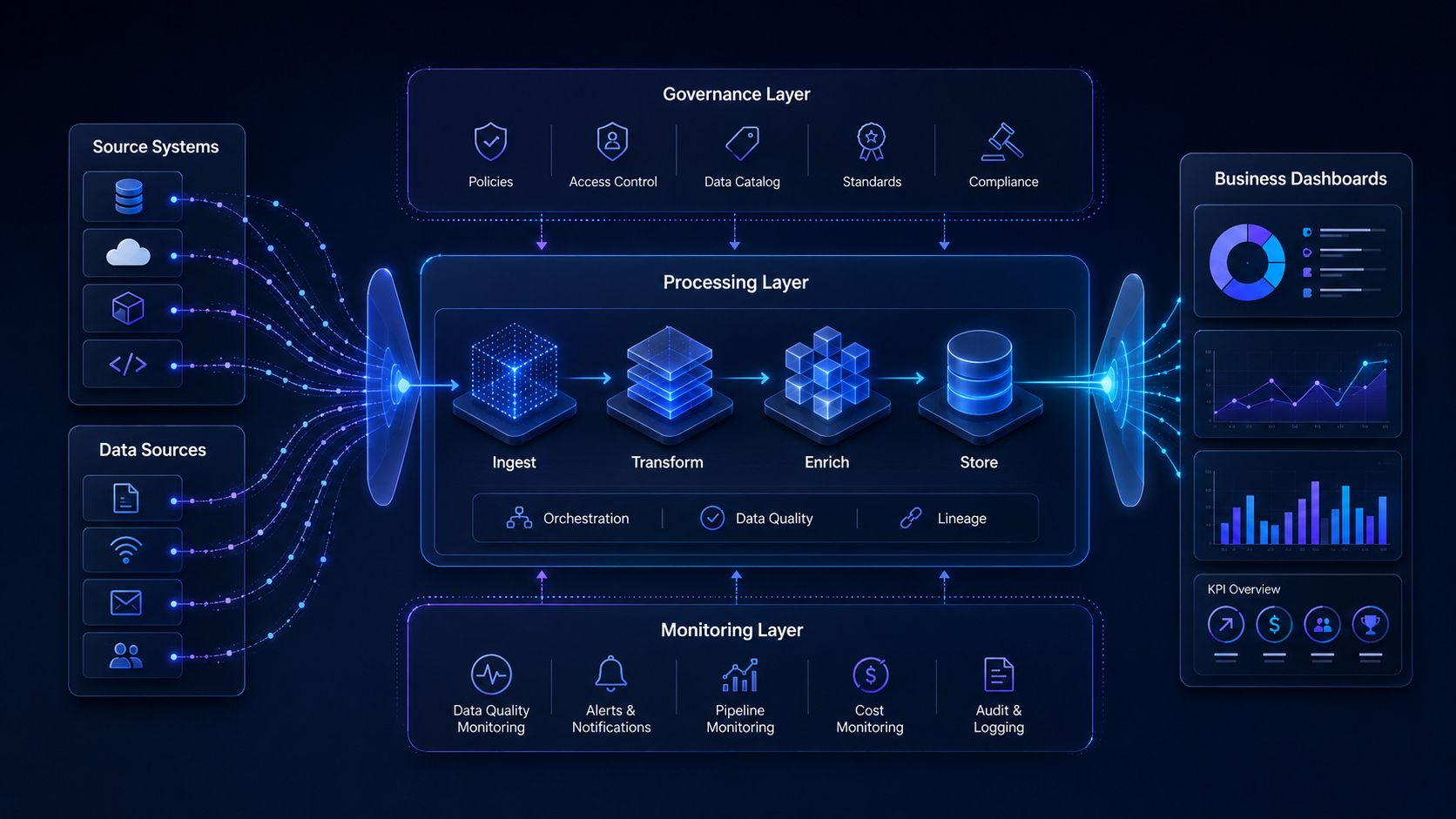
Trusted data requires technical controls and business controls.
Engineering is essential, but it cannot replace business validation. A trusted operating model makes both visible.
Technical controls
They confirm that the data platform is running as expected.
- Pipeline execution
- Schema changes
- Table loads
- Job failures
- Infrastructure alerts
Business controls
They confirm that the data makes sense for the business decision.
- Completeness and validity
- Duplicates and reconciliation
- Approved KPI definitions
- Freshness and source arrival
- Business-rule compliance
Operating model
How to make business data more trustworthy
Improving data trust requires a structured approach. It is not about fixing one dashboard or cleaning one table. It is about building a data operating model where quality, governance, and accountability are part of daily business operations.
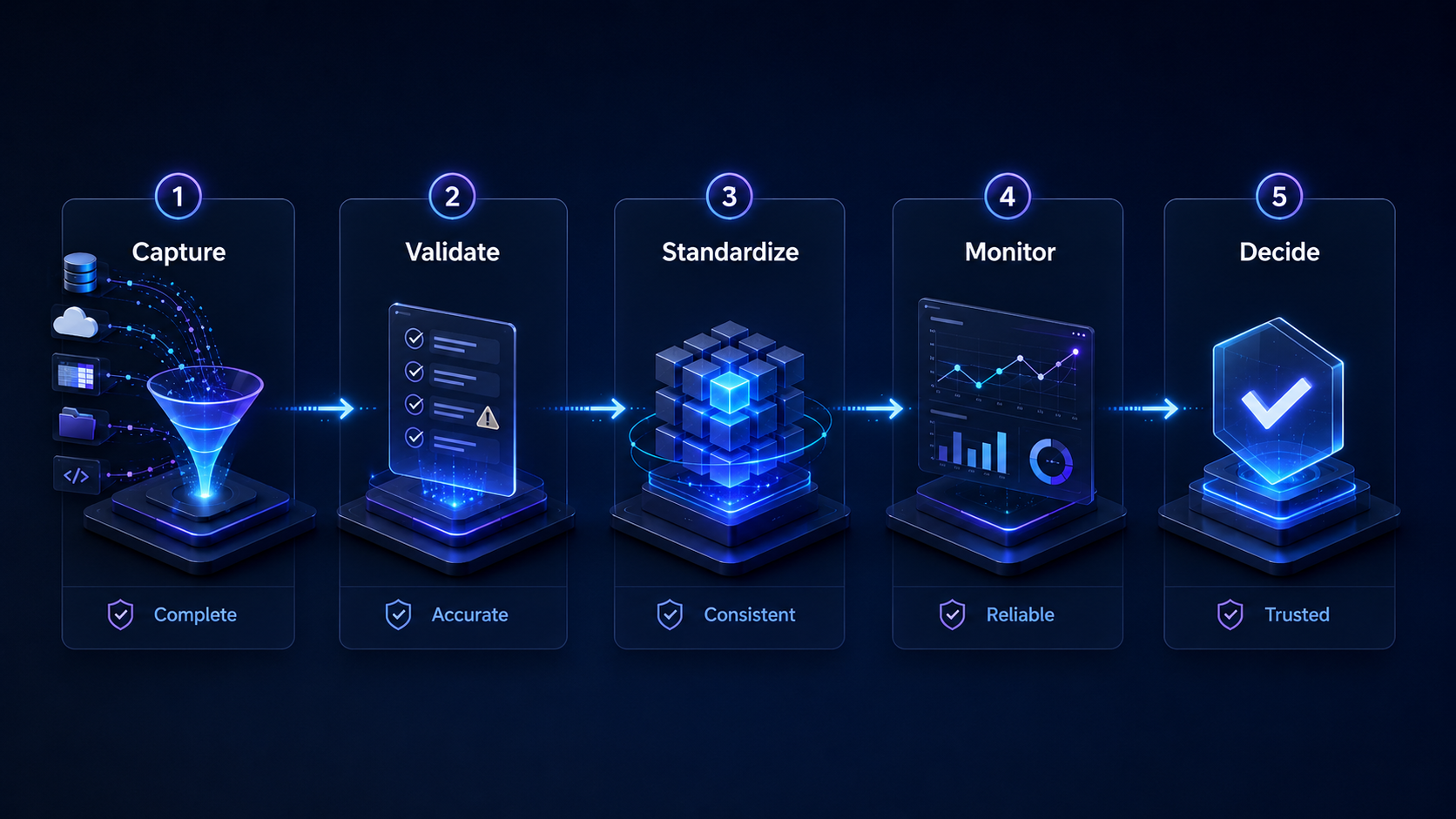
Identify the critical data domains that support strategic decisions, regulatory reporting, financial performance, customer operations, revenue operations, and executive dashboards.
Define clear ownership for each critical domain, entity, KPI, and reference dataset.
Standardize definitions so key business terms and metrics are approved once and implemented consistently.
Implement controls for completeness, uniqueness, validity, consistency, freshness, and reconciliation.
Make lineage visible from source systems to transformations, semantic layers, reports, and dashboards.
Monitor continuously with alerts, incident management, quality checks, and trend analysis.
Connect governance with execution so policies become controls, documentation links to systems, and rules are tested automatically.
Operating model
Data trust is a business capability
The companies that succeed with data are not only the ones that collect the most information. They are the ones that can rely on their data to make decisions with confidence.
Data trust is not just a technical outcome. It is a business capability. It depends on the way the organization defines its concepts, manages its systems, controls its processes, assigns ownership, monitors quality, and handles change.
When data is trusted, decisions become faster. Governance becomes stronger. Teams align around shared facts. Leaders gain confidence. Data teams spend less time firefighting and more time creating value.
The real challenge is not simply building more reports. It is building a trusted operating layer where business data is accurate, governed, explainable, and usable. Because in the end, data only creates value when people trust it enough to act on it.
From data doubt to operational trust
Trust is built when governance becomes operational.
Reliable business data needs shared language, explicit rules, visible lineage, monitored quality, accountable owners, and a clear way to resolve issues before they affect decisions.
Discuss your data trust model