
Data Governance

By Mohamed KHEY
May 21, 2026
Building a Data Governance Operating Model
Data governance becomes useful only when it changes how teams work every day: who owns the data, which rules must be respected, how exceptions are handled, and how decisions are made.
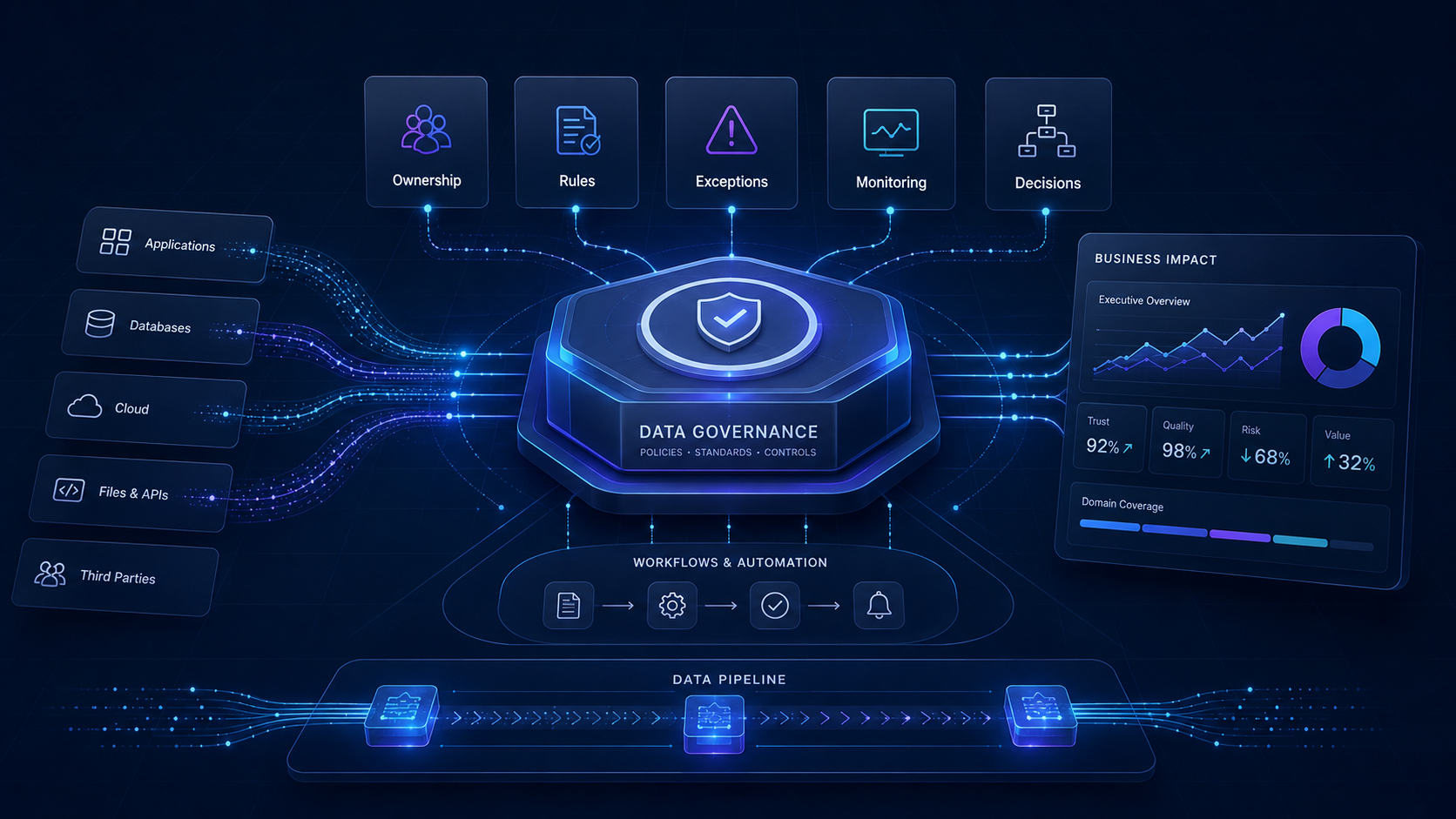
Many companies talk about governance as a policy, a committee, or a set of principles. In practice, governance creates value only when it becomes operational.
A data governance operating model is the system that turns governance from an abstract concept into a practical way of working. It connects people, processes, rules, tools, and routines so that data is not only documented, but actively managed, monitored, and improved.
The goal is not bureaucracy. The goal is clarity. A strong operating model helps teams know exactly what to do when data is incorrect, incomplete, duplicated, inconsistent, or not trusted.
Business risk
Why Data Governance Needs an Operating Model
As businesses grow, data becomes more complex. Customer data lives in CRM systems. Financial data lives in ERP systems. Product data lives in operational tools. Sales, marketing, finance, operations, and leadership teams all consume the same data through dashboards, spreadsheets, reports, and applications.
Without governance, each team develops its own definitions, rules, and workarounds. At first this may seem manageable. A missing field can be corrected in a spreadsheet. A duplicate customer can be handled by someone who knows the business context.
But as the organization scales, these small issues become structural risks. The same KPI may have different definitions across departments. Quality problems may reach executive dashboards. Teams may lose confidence in reports. Operational decisions may be delayed because people are debating the data instead of acting on it.
Schema 01
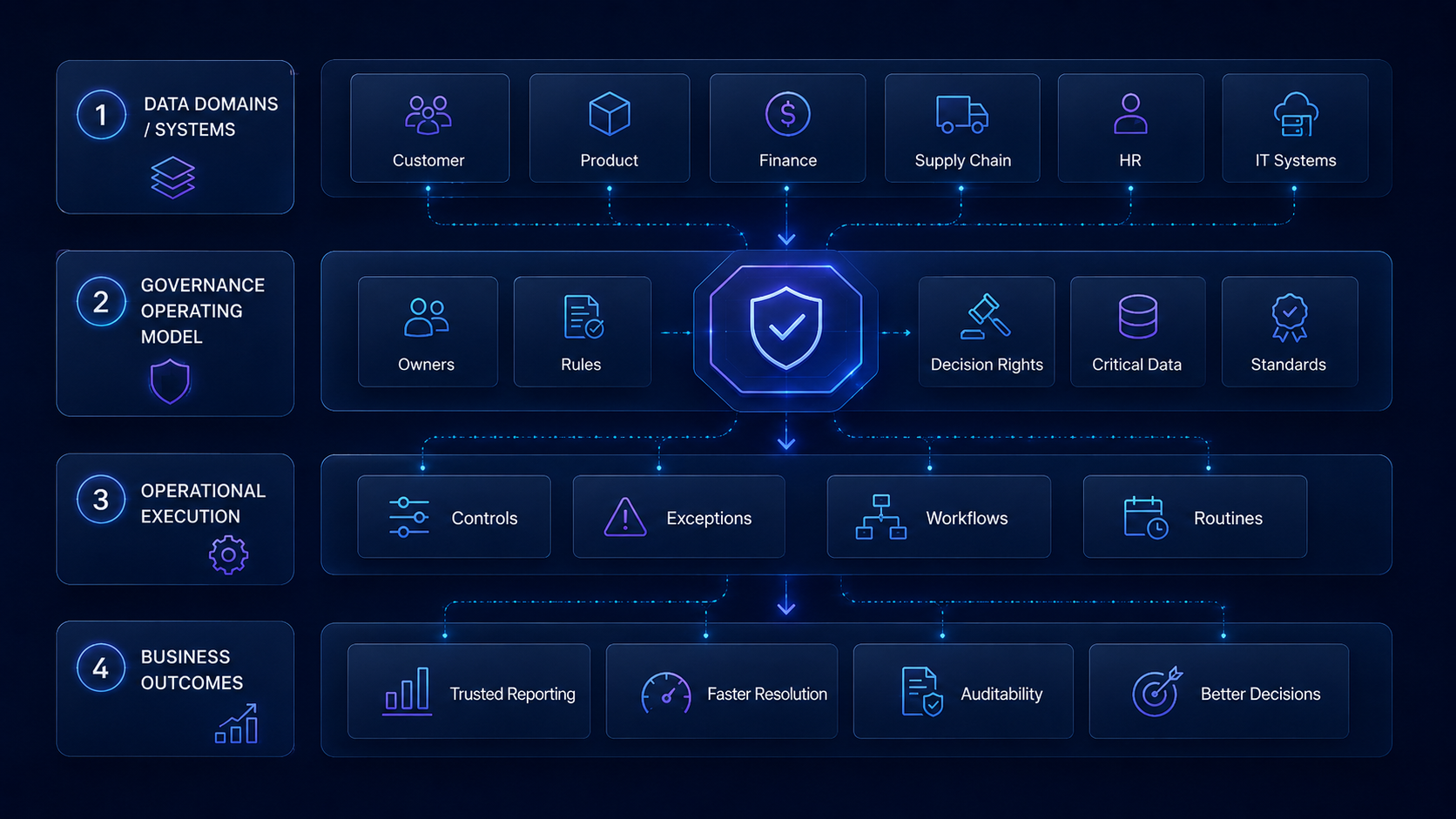
The Operating Model Connects Ownership, Rules, Controls, and Decisions
A governance operating model defines how governance works in practice. It answers who owns data, who fixes issues, which rules are mandatory, how exceptions are escalated, how definitions are updated, and how decisions are documented.
The model becomes useful when the loop is closed: business expectations become rules, rules become controls, controls reveal exceptions, exceptions trigger workflows, and decisions improve the standards.
What the model answers
Governance Becomes Practical When Every Important Question Has an Owner
The operating model is the bridge between governance intent and day-to-day execution. These questions should not depend on informal memory or personal relationships.
Operational discipline
Governance Must Be Operational, Not Theoretical
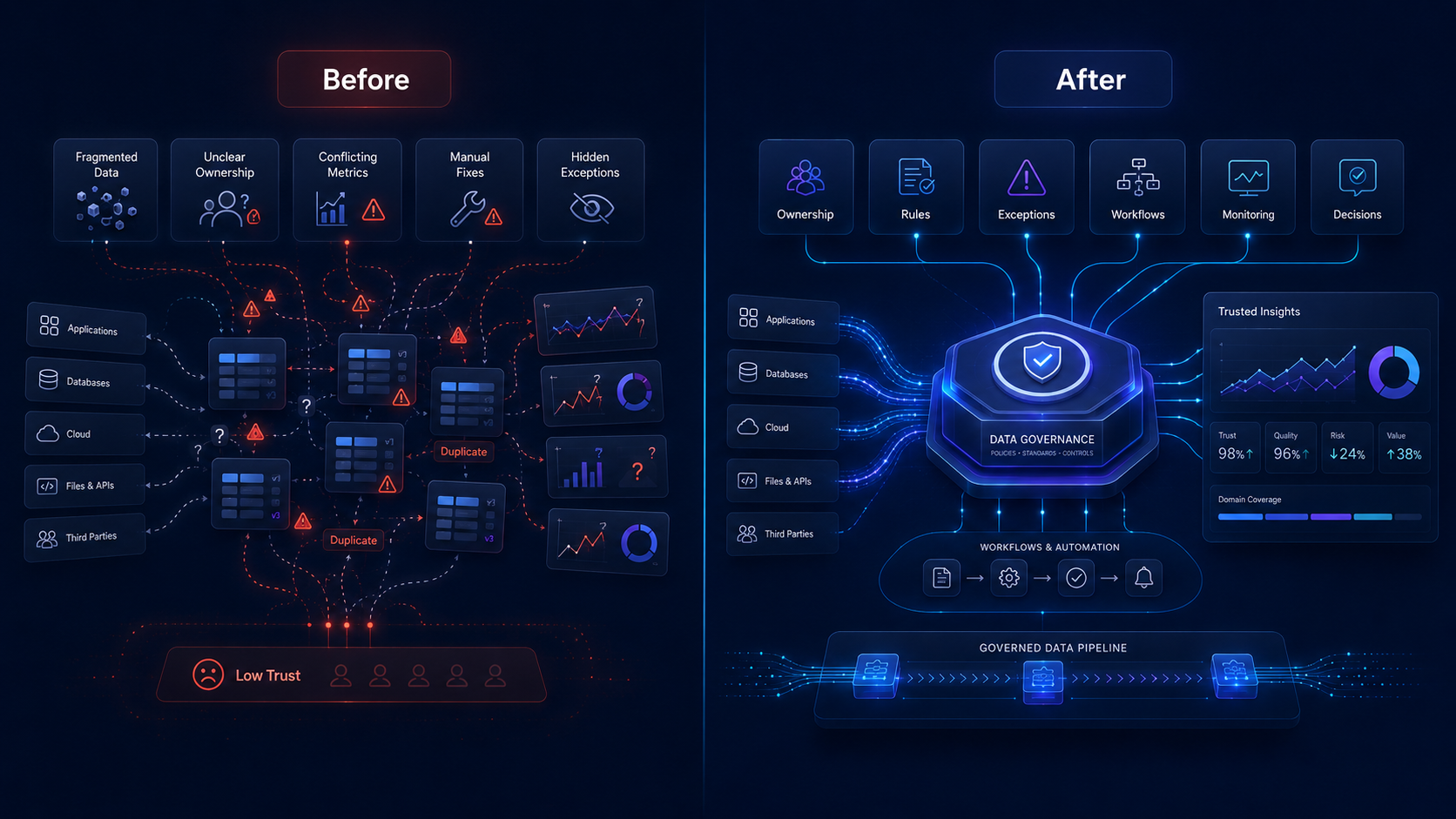
The biggest mistake companies make with data governance is treating it as a documentation project. They create glossaries, policies, data catalogs, and governance committees, but the daily problems remain the same.
Reports are still questioned. CRM fields are still incomplete. Business definitions are still inconsistent. Quality issues are still discovered too late. Ownership is still unclear when something breaks.
Operational governance means rules are not only written in documents; they are implemented in systems. Owners are not only named in a matrix; they review issues. Exceptions are not hidden in pipelines; they are visible, assigned, prioritized, and resolved.
Core components
The Core Components of a Data Governance Operating Model
A complete operating model is built around the components that make data meaningful, accountable, controlled, and continuously improved.
Data domains
Organize governance around business meaning such as customer, supplier, product, finance, sales, employee, asset, or contract data.
Ownership
Name the business owner, steward, technical custodian, consumers, system owners, and sponsor for each priority domain.
Decision rights
Define who can approve KPI definitions, reference values, quality rules, exceptions, mandatory fields, and cross-domain decisions.
Business definitions
Create approved, versioned, accessible definitions for entities, attributes, metrics, statuses, and reference values.
Quality rules
Translate business expectations into executable checks for completeness, uniqueness, validity, consistency, accuracy, timeliness, and integrity.
Exception management
Make non-compliant records, events, metrics, and process outputs visible, assigned, prioritized, resolved, and closed.
Escalation paths
Separate low, medium, high, and critical issues so business risks are reviewed at the right level.
Governance routines
Create weekly, monthly, and quarterly moments where the right people review issues, rules, definitions, and performance.
Governance KPIs
Measure rule coverage, open exceptions, resolution time, recurring issues, owner assignment, certified data products, and incident frequency.
Policies and standards
Keep policies practical by embedding standards into tools, workflows, controls, access reviews, and lifecycle processes.
Business meaning
1. Data Domains
The first step is to organize data around business domains. Governance cannot be managed effectively only at the level of individual tables or dashboards. Data must be governed according to business meaning.
For example, customer is not just a table in a CRM. It may exist in marketing tools, billing systems, support platforms, and reporting layers. The model must define what a customer means across the organization and which system is the source of truth for each attribute.
Accountability
2. Data Ownership
Ownership is one of the most important elements of governance. When nobody owns the data, nobody is accountable for its quality.
A good operating model does not only list roles. It defines what each role actually does when a record is duplicated, a field is missing, a KPI conflicts, a rule fails, or downstream reports need correction.
Roles
Ownership Works When Responsibilities Are Concrete
The model should make it clear who validates, who fixes, who implements, who consumes, and who escalates.
Data owner
A senior business stakeholder accountable for domain definitions, business rules, access principles, and quality expectations.
Data steward
The day-to-day role that reviews exceptions, manages definitions, coordinates remediation, and keeps governance moving.
Data custodian
The technical team responsible for storage, pipelines, security, processing, availability, and implementation of controls.
Data consumer
Any team using the data for reporting, analysis, operations, automation, AI, or decision-making.
Decision rights
Many Data Issues Are Business Decisions, Not Technical Bugs
Who can approve a KPI definition? Who can change a reference value? Who validates a data quality rule? Who approves an exception? Who arbitrates when departments disagree?
If sales and finance define active customer differently, the data team cannot solve the issue alone. The business must align on the official definition, document it, and apply it consistently.
Decision matrix
Decision rights by governance topic
The purpose is to avoid endless discussion and unclear accountability.
Glossary in action
Business Definitions Create the Shared Language
A data governance operating model must establish a shared language. If teams do not agree on what a metric, entity, or attribute means, they cannot trust the data.
Definitions should be clear, approved, versioned, accessible, and linked to systems, reports, data products, and quality rules. A definition should not sit alone in a document. It should influence how data is captured, transformed, validated, and reported.
Prioritization
Critical Data Elements Keep Governance Focused
Not all data needs the same level of governance. Trying to govern everything at once usually leads to complexity and slow adoption.
A critical data element is a field, metric, attribute, or reference value that is essential for business operations, reporting, compliance, or decision-making. By focusing on critical elements, organizations govern where it matters most.
Executable rules
Data Quality Rules Turn Expectations Into Controls
Governance becomes powerful when business expectations are translated into explicit rules. A data quality rule defines what good data looks like.
The strongest models classify rules by dimension, but the most important point is simple: rules must be executable. A rule that cannot be checked is only a recommendation.
Quality dimensions
Rules should cover the dimensions that matter
- Completeness
- Uniqueness
- Validity
- Consistency
- Accuracy
- Timeliness
- Integrity
Schema 02
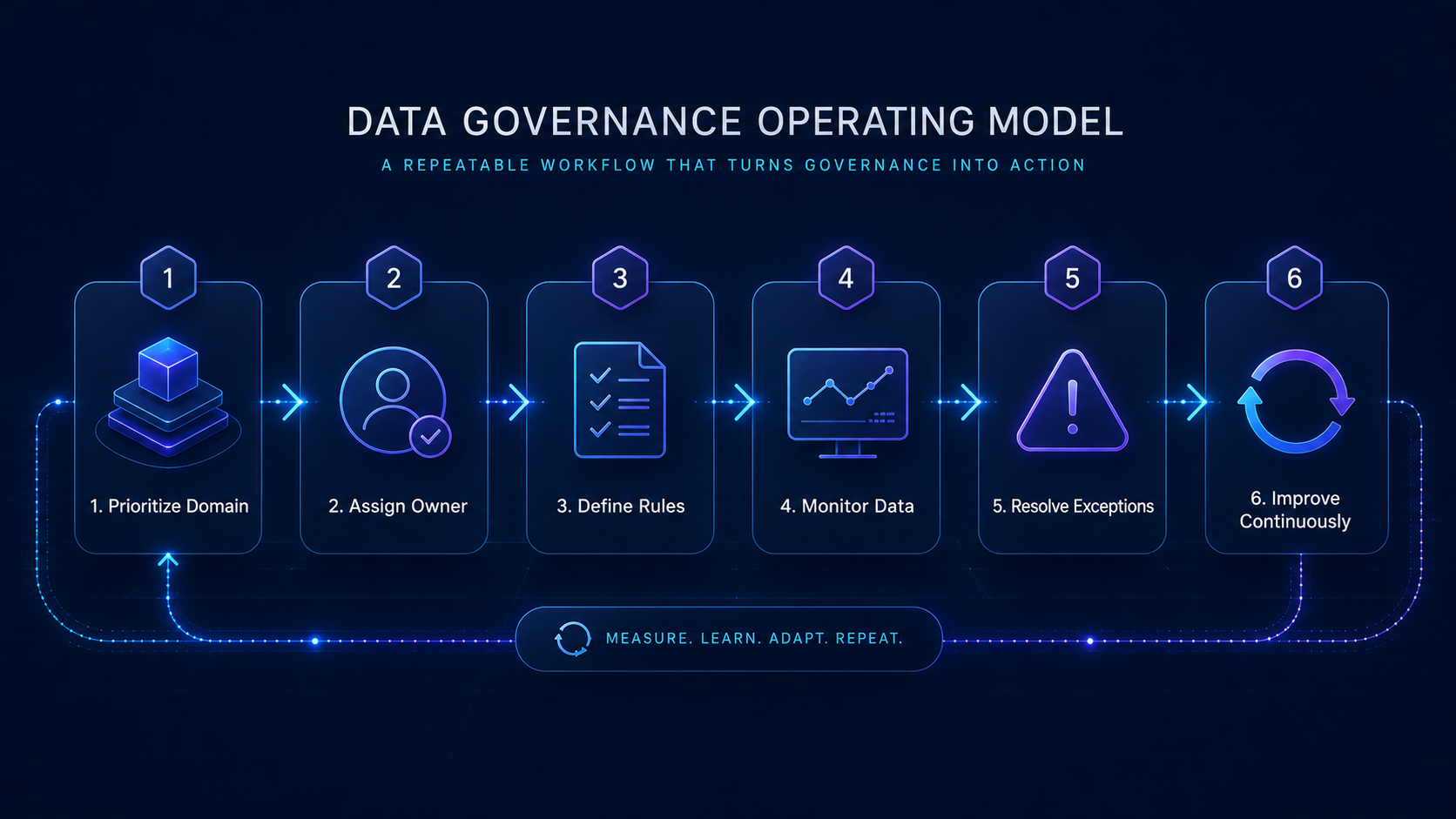
Exception Management Turns Governance Into an Operational Workflow
Every organization has data exceptions. The issue is not that exceptions exist. The issue is when nobody sees them, owns them, or resolves them.
An exception is any record, event, metric, or process output that does not comply with an agreed rule. The process should include detection, classification, assignment, prioritization, resolution, validation, closure, and root cause analysis.
Impact and priority
Every Exception Should Carry Business Context
A failed rule is only useful when it explains what happened, why it matters, who owns it, and what must happen next.
This helps teams detect and resolve issues before they affect executive meetings, financial close, customer operations, regulatory obligations, or AI systems.
Operating cadence
Governance Routines Create Rhythm
Governance needs routines. Without routines, governance becomes reactive. The goal is not to add meetings for the sake of meetings, but to create structured moments where the right people make the right decisions with the right information.
Weekly data quality review
Review critical exceptions, blocked issues, and repeated rule failures.
Monthly domain governance meeting
Validate definitions, rules, ownership gaps, and domain priorities.
Quarterly governance council
Resolve cross-domain decisions, policy changes, escalations, and maturity priorities.
Post-incident root cause analysis
Understand what broke, what was impacted, and which controls must improve.
Governance KPIs
Governance Must Be Measurable
If governance is not measured, it becomes difficult to prove value. The best KPIs are not only technical. They connect governance to business outcomes.
Reducing duplicate customer records, for example, can improve sales productivity, marketing targeting, customer experience, and reporting accuracy.
- Percentage of critical data elements covered by controls
- Number of open exceptions
- Average time to resolve data issues
- Number of recurring issues
- Percentage of domains with assigned owners
- Percentage of KPIs with approved definitions
- Data freshness SLA compliance
- Number of manual corrections
- Data incident frequency
Schema 03
Governance and Data Quality Must Work Together
Data governance and data quality are closely connected, but they are not the same thing. Governance defines the accountability, rules, standards, and decision-making model. Data quality measures whether the data meets expectations.
Governance defines what should happen. Data quality shows whether it is happening.
Without governance, quality checks lack business ownership. Without quality monitoring, governance lacks operational visibility.
Tools
Technology Supports the Model, But Does Not Replace It
Technology helps governance scale through data cataloging, business glossaries, metadata management, lineage, quality monitoring, MDM, reference data, workflow, access control, policy enforcement, observability, and dashboards.
But tools alone do not create governance. Many companies buy governance platforms but fail to define ownership, decision rights, rules, and routines. Design the operating model first, then support it with tools.
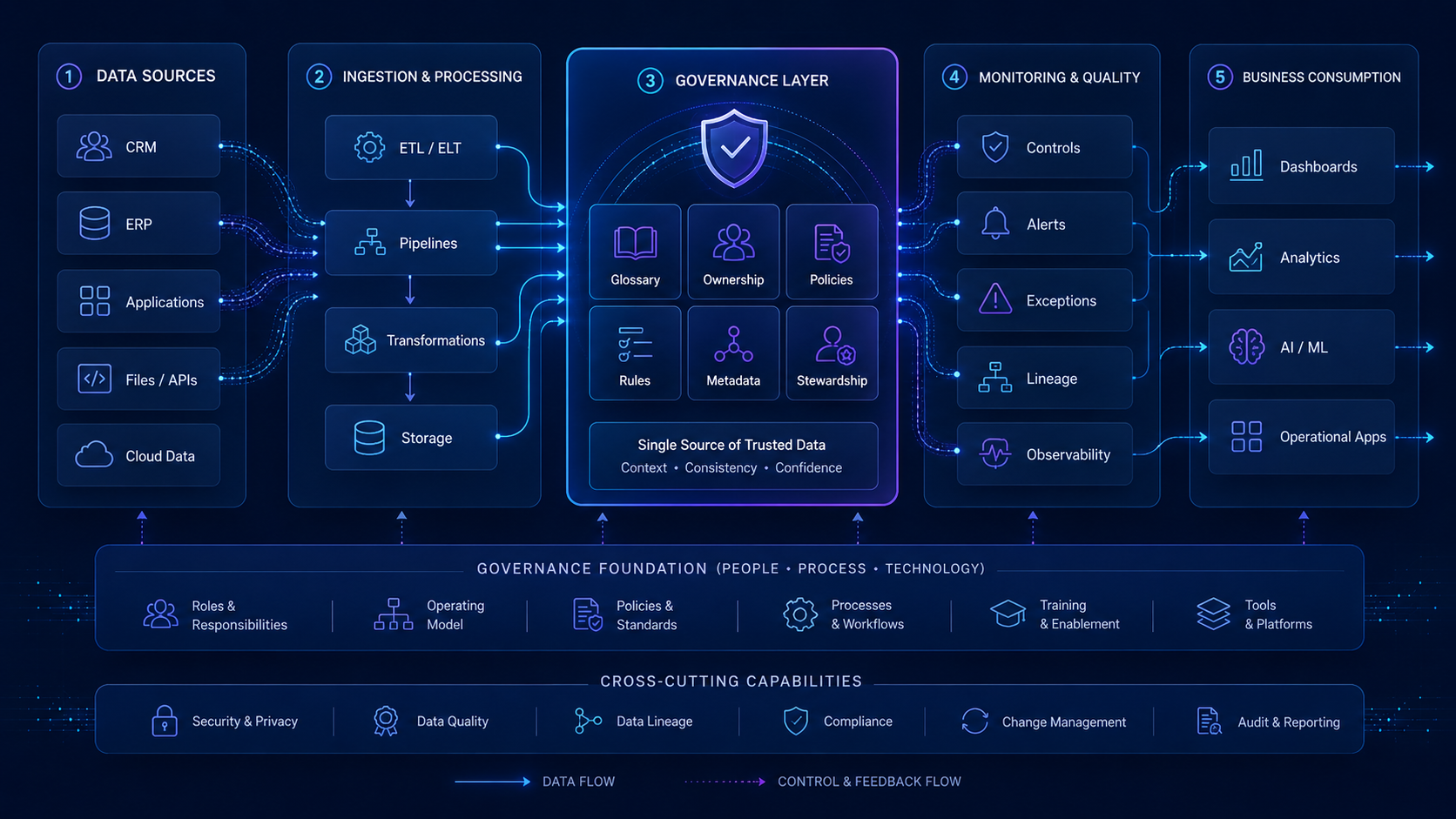
Operating layers
A Strong Model Connects Strategy, Tactics, and Operations
If strategy does not reach operations, governance becomes theoretical. If operations are not connected to strategy, governance becomes fragmented.
Strategic layer
Defines vision, principles, sponsorship, priority domains, maturity goals, and the business risks governance must address.
Executives, senior business leaders, governance sponsors
Tactical layer
Translates strategy into domain-level ownership, policies, standards, definitions, CDEs, quality rules, roadmaps, and priorities.
Data owners, stewards, data leaders, architects, governance leads
Operational layer
Executes quality controls, exception management, issue resolution, metadata updates, rule monitoring, access reviews, and remediation.
Stewards, engineers, analysts, system owners, operational teams
Organization design
Centralized, Decentralized, or Federated?
The right governance organization depends on company size, culture, regulatory constraints, data maturity, and organizational structure.
A federated model is often the most effective model for growing organizations because it combines central coordination with domain-level ownership.
Centralized
Strength: Consistency, oversight, and strong coordination.
Risk: May become disconnected from domain realities if the central team is too far from operations.
Decentralized
Strength: Flexibility and proximity to business needs.
Risk: Definitions, rules, and practices can diverge across teams.
Federated
Strength: Central standards with domain ownership and local execution.
Risk: Requires clear decision rights, strong routines, and active coordination.
Decision forum
The Role of the Data Governance Council
A governance council is useful when it has a clear purpose. It should not be a symbolic committee. Its role is to resolve cross-domain decisions, approve standards, prioritize initiatives, remove blockers, and monitor progress.
The council should focus on decisions that cannot be solved at the operational level: enterprise KPI definitions, ownership conflicts, priority domains, major policy changes, high-impact incidents, and governance maturity.
Roadmap
Build the Operating Model Step by Step
A practical governance operating model can be built progressively. Start with business pain, prove value in priority domains, then scale the routines and controls.
Identify business pain points
Start with real problems: untrusted reports, incomplete CRM data, mismatched finance and sales numbers, duplicate customers, delayed refreshes, manual corrections, or AI blocked by poor data quality.
Select priority domains
Choose one to three domains where governance can create visible impact, such as customer, supplier, product, finance, or operational data.
Define ownership
Document the owner, steward, technical owner, system owners, main consumers, and governance sponsor for each priority domain.
Define critical data elements
Identify the fields, metrics, attributes, and reference values used in strategic decisions, operations, reporting, compliance, and cross-system processes.
Define business rules
Clarify mandatory fields, valid formats, allowed values, freshness expectations, uniqueness, consistency checks, authoritative sources, and change rights.
Implement controls
Translate rules into automated checks in source systems, pipelines, warehouses, MDM tools, applications, and monitoring platforms.
Make exceptions visible
Use dashboards, alerts, and workflows to show which rules failed, which records are impacted, who owns the issue, and what action is required.
Create resolution workflows
Move issues through detection, qualification, assignment, prioritization, correction, validation, closure, root cause analysis, and preventive action.
Establish governance routines
Create recurring review moments that answer what changed, what broke, what is at risk, what needs a decision, and what must improve.
Measure and improve
Track performance, improve rules, automate more controls, clarify ownership, reduce recurrence, and expand to new domains over time.
Common mistakes
Where Governance Operating Models Usually Fail
Most failures come from treating governance as a static framework instead of an operating discipline.
Starting with tools instead of accountability
Buying a governance platform does not solve unclear ownership or weak decision rights.
Creating too much bureaucracy
If every small decision needs a committee, teams will bypass the model.
Governing too much too soon
Trying to control every data asset at once creates complexity and slow adoption.
Separating governance from operations
Policies, catalogs, and committees do not help if rules are not embedded in systems and workflows.
Ignoring business ownership
Data teams can process and monitor data, but business teams must own meaning, rules, and priorities.
Measuring activity instead of value
Glossary counts are less important than fewer incidents, faster resolution, less manual work, and better decision quality.
Customer domain
Example: Operational Governance for Customer Data
Consider a company struggling with customer data quality. The CRM contains duplicates. Some records miss industry, country, or lifecycle stage. Marketing reports do not match sales reports. Finance has a different view of active customers.
The model addresses this systematically. Customer data becomes a priority domain. A sales or revenue leader becomes the owner. A RevOps manager becomes the steward. Data engineering becomes the custodian.
Automated controls detect duplicate records, missing values, invalid statuses, and synchronization failures. Weekly, the RevOps team reviews exceptions. High-impact issues are escalated to the owner. Recurring problems improve forms, validation rules, integrations, and processes.
Critical elements
Customer Data Elements
- Customer ID
- Company name
- Country
- Industry
- Lifecycle stage
- Account owner
- Legal identifier
- Customer status
- Revenue segment
Business rules
Customer Governance Rules
- Every customer must have a unique ID.
- Country must match an approved reference list.
- Lifecycle stage must follow predefined values.
- Active customers must have at least one active contract or subscription.
- Duplicate detection must run daily.
- Customer status must be synchronized between CRM and billing.
AI readiness
Governance Is a Foundation for Scalable AI
AI increases the importance of governance. Models, automations, customer intelligence, forecasting, and decision support all depend on trusted data foundations.
Poor governance creates models trained on inconsistent data, automations based on incorrect rules, AI outputs that cannot be explained, bias from incomplete records, lack of lineage for sensitive data, and no accountability for data used in AI systems.
MDM
Governance and Master Data Management Reinforce Each Other
MDM manages core entities such as customers, suppliers, products, employees, assets, and locations. Governance defines who owns these entities, which rules apply, and how conflicts are resolved.
MDM provides operational capability for golden records, deduplication, validation workflows, reference values, and synchronization. Governance provides the accountability model.
Maturity
What a Mature Governance Operating Model Looks Like
In a mature model, governance is not seen as a constraint. It is seen as an enabler of better decisions, faster operations, safer growth, and stronger AI readiness.
- Each critical domain has an accountable owner.
- Business definitions are documented and used consistently.
- Critical data elements are identified and monitored.
- Data quality rules are automated.
- Exceptions are visible and assigned.
- Issue resolution workflows are active.
- Data incidents are analyzed and prevented.
- Governance KPIs are reviewed by leadership.
Value
The Business Value of a Governance Operating Model
The value of governance is not the framework itself. The value is the reduction of confusion, risk, rework, manual correction, and decision delay.
When data ownership is clear, rules are explicit, exceptions are visible, and routines are in place, teams can trust the data they use to run the business.
Conclusion
Data Governance Becomes Powerful When It Becomes Operational
A policy document is not enough. A data catalog is not enough. A committee is not enough. Organizations need a practical operating model that defines owners, rules, decision rights, exception workflows, routines, and performance indicators.
The best models do not slow teams down. They help teams act with confidence, make issues visible before they become business problems, and connect business ownership with technical execution.
Build your governance model