
Global Data Strategy

By Mohamed KHEY
January 23, 2026
Unified data architecture for complex operations
Complex organizations do not need another disconnected dashboard. They need a data architecture that aligns systems, ownership, rules, quality controls, and reporting into one trusted operating layer.

In many companies, data is available everywhere but trusted nowhere. Finance, operations, sales, logistics, quality, and management can all look at different dashboards and still disagree on the same basic question: what is the true number?
The issue is rarely a lack of data. The real problem is that data moves through disconnected systems without shared ownership, common definitions, quality gates, or monitored lineage. Teams spend too much time reconciling numbers, correcting spreadsheets, questioning reports, and waiting for technical investigations.
A unified data architecture solves this at the structural level. It creates a controlled operating layer where data is collected, validated, standardized, documented, monitored, and delivered to the right people with enough context to be trusted.
What a unified data architecture really means
A unified data architecture is the foundation that connects operational systems, business rules, data governance, quality controls, security, and reporting into one coherent model. It is not only a warehouse, a pipeline, or a dashboard. It is the architecture behind reliable decisions.
The goal is not to replace every system. Most complex organizations will continue to use specialized tools for finance, sales, production, logistics, customer service, and quality. The goal is to make those systems work together through shared standards, governed entities, observable rules, and trusted outputs.
Why disconnected dashboards are not enough
Dashboards are useful, but they are only the visible surface of the data ecosystem. If the underlying data is inconsistent, duplicated, incomplete, late, or poorly governed, a dashboard can create the impression of control while hiding structural risk.
A KPI can look precise while still being based on a local definition, a manual extract, an outdated reference table, or a pipeline that silently changed. In complex operations, those small weaknesses become expensive. One wrong number can affect budgets, customer commitments, performance reviews, compliance evidence, or operational priorities.
Reference schema
One operating layer between systems and decisions
A unified architecture creates a governed middle layer. It connects operational data sources to business consumption through rules, controls, lineage, and ownership.
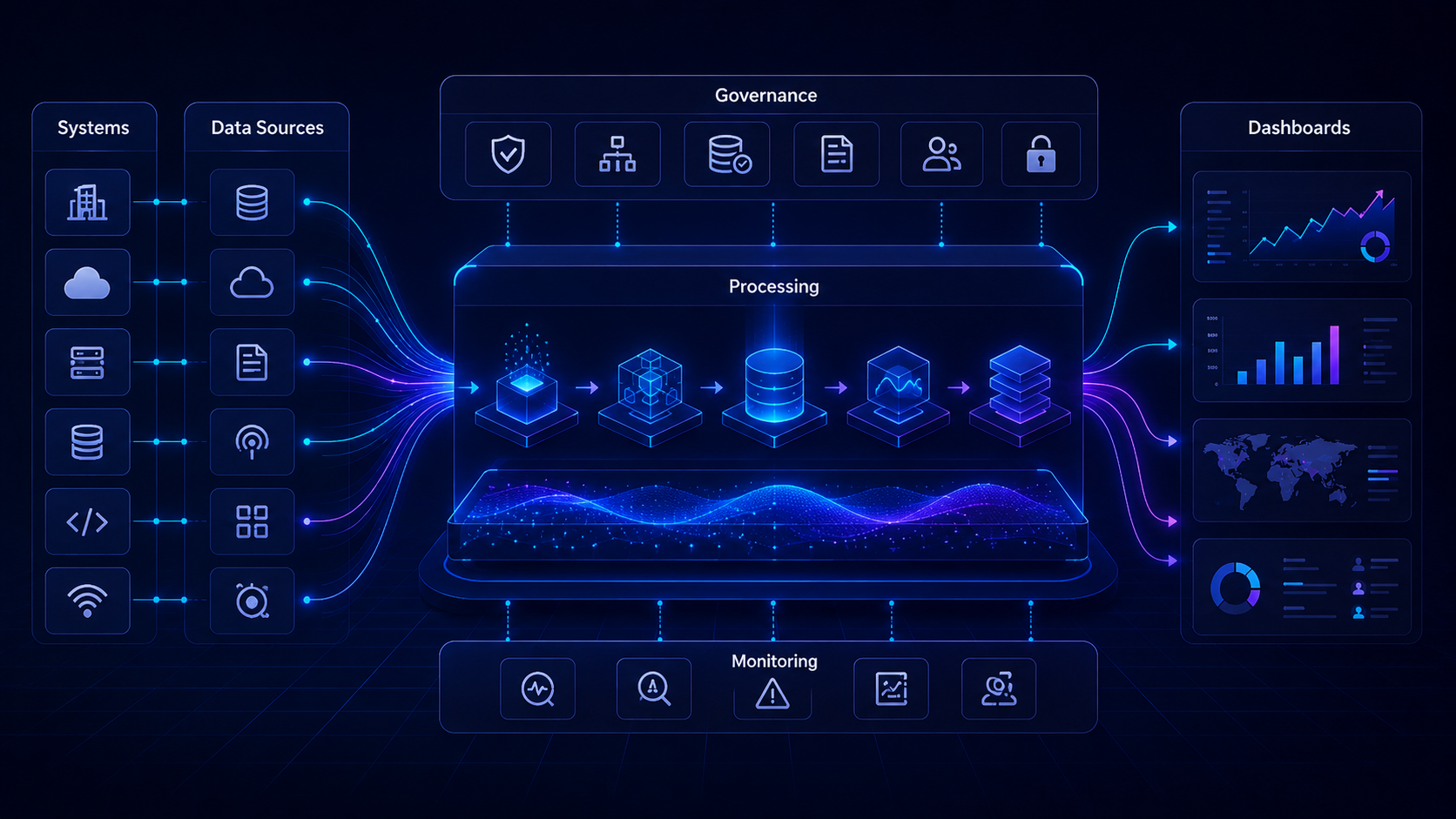
Example operational systems connected by the architecture
The point is not one tool. The point is one governed architecture across many tools.
The need for one trusted operating layer
A unified architecture creates a single layer of trust between operational systems and business reporting. This layer centralizes the logic that matters: definitions, ownership, master data, validation rules, transformations, security, lineage, and monitoring.
The best architectures make trust operational. Teams do not need to ask whether a report is reliable every month. They can see which dataset is certified, which rule was applied, which source is authoritative, whether the data arrived on time, and who owns the fix when an exception appears.
Key components of a unified data architecture
Clear data ownership
Every critical dataset needs a named owner who is accountable for meaning, quality, lifecycle, and escalation. Without ownership, data issues become everybody's problem and nobody's decision.
Standardized business rules
Terms such as active customer, validated supplier, completed order, or monthly revenue must be defined once and applied consistently across reports and workflows.
Reliable quality controls
Completeness, format, duplicate, referential integrity, freshness, anomaly, and business-rule checks should run continuously before data reaches decision layers.
Master data and referentials
Customers, suppliers, products, assets, locations, cost centers, currencies, and departments need clean identifiers and governed synchronization across systems.
Pipeline observability
Data operations must track execution, freshness, volume shifts, schema changes, failures, delays, and downstream impact so incidents are detected early.
Trusted reporting layer
Dashboards and analytical models should be built from validated, documented, secured, and governed data products rather than isolated local extracts.
Trust test
If the number changes, can you explain why?
A trustworthy architecture gives a clear answer: source change, rule change, pipeline change, correction, late data, or real business movement.
Control model
Operational trust is built layer by layer
Trust becomes scalable when each layer has a clear purpose and visible evidence. This turns governance from documentation into day-to-day operating control.
How to move from fragmentation to trust
Many organizations try to solve data problems by adding more dashboards, more tools, or more manual checks. Without a unified architecture, this usually increases complexity. The better path is to make the operating model explicit, then build the technical layer around it.
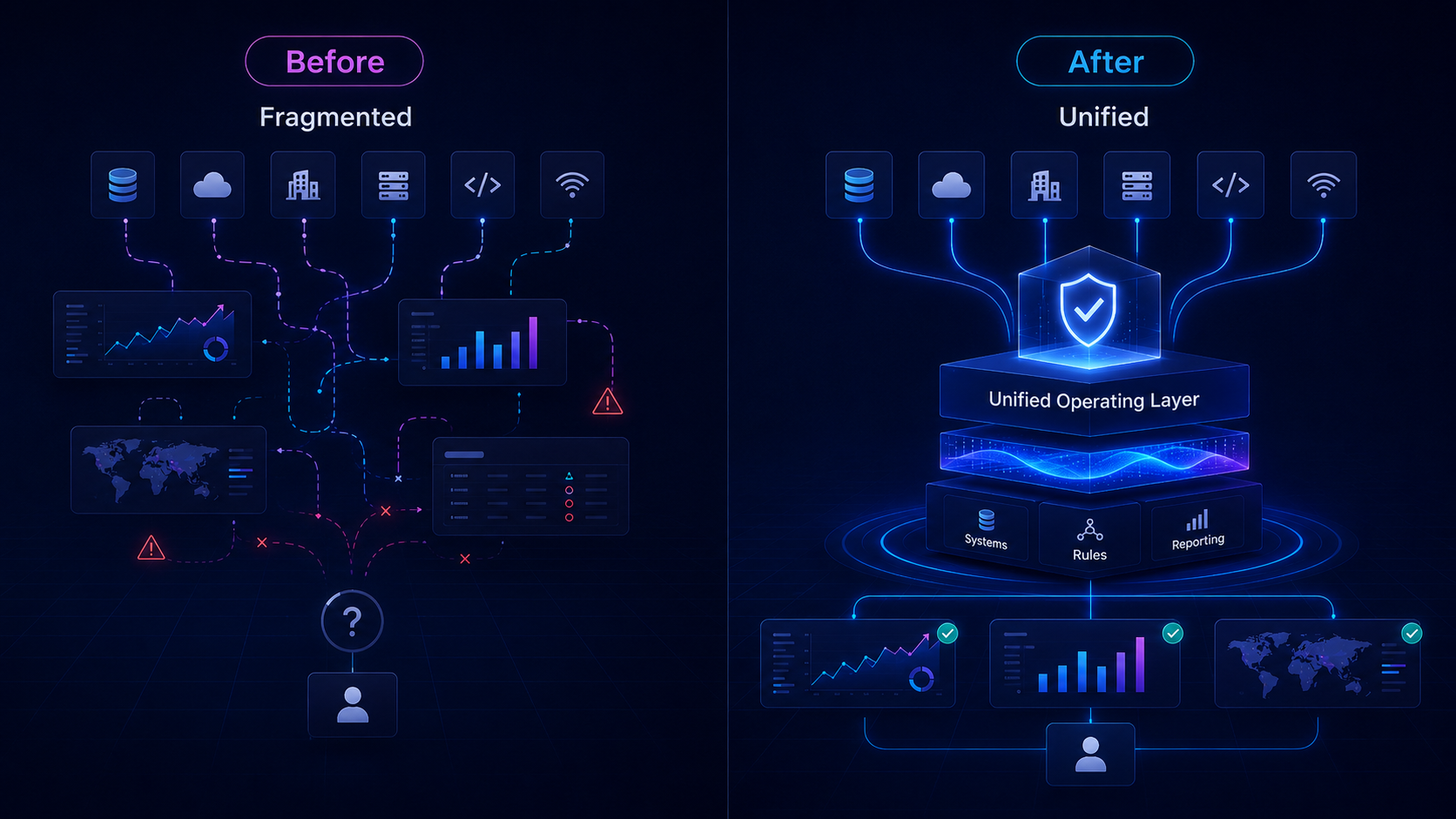
Start with the business decisions and KPIs that need to be trusted.
Identify the systems of record, the data owners, and the current points of manual correction.
Standardize core entities, statuses, rules, and referentials before multiplying dashboards.
Embed quality checks and observability into pipelines so issues are detected before reporting cycles.
Publish governed data products with documentation, lineage, access rules, and clear support routines.
Benefits for complex organizations
A unified architecture reduces time spent investigating data issues, improves trust in KPIs, creates accountability around ownership, reduces manual corrections, and gives leadership a more reliable view of performance.
For operational teams, it means fewer recurring data problems. For data teams, it means a platform that can scale without becoming fragile. For executives, it means decisions can be based on numbers that are consistent, explainable, and controlled.
From data volume to operational trust
Trust is not created by dashboards alone.
It is created by the architecture behind them: clear ownership, reliable rules, automated quality controls, governed referentials, monitored pipelines, secure access, and reporting layers that can be explained when the business depends on them.
Discuss your data architecture