
Data Reliability

By Mohamed KHEY
March 19, 2026
Scaling data trust for a growing business
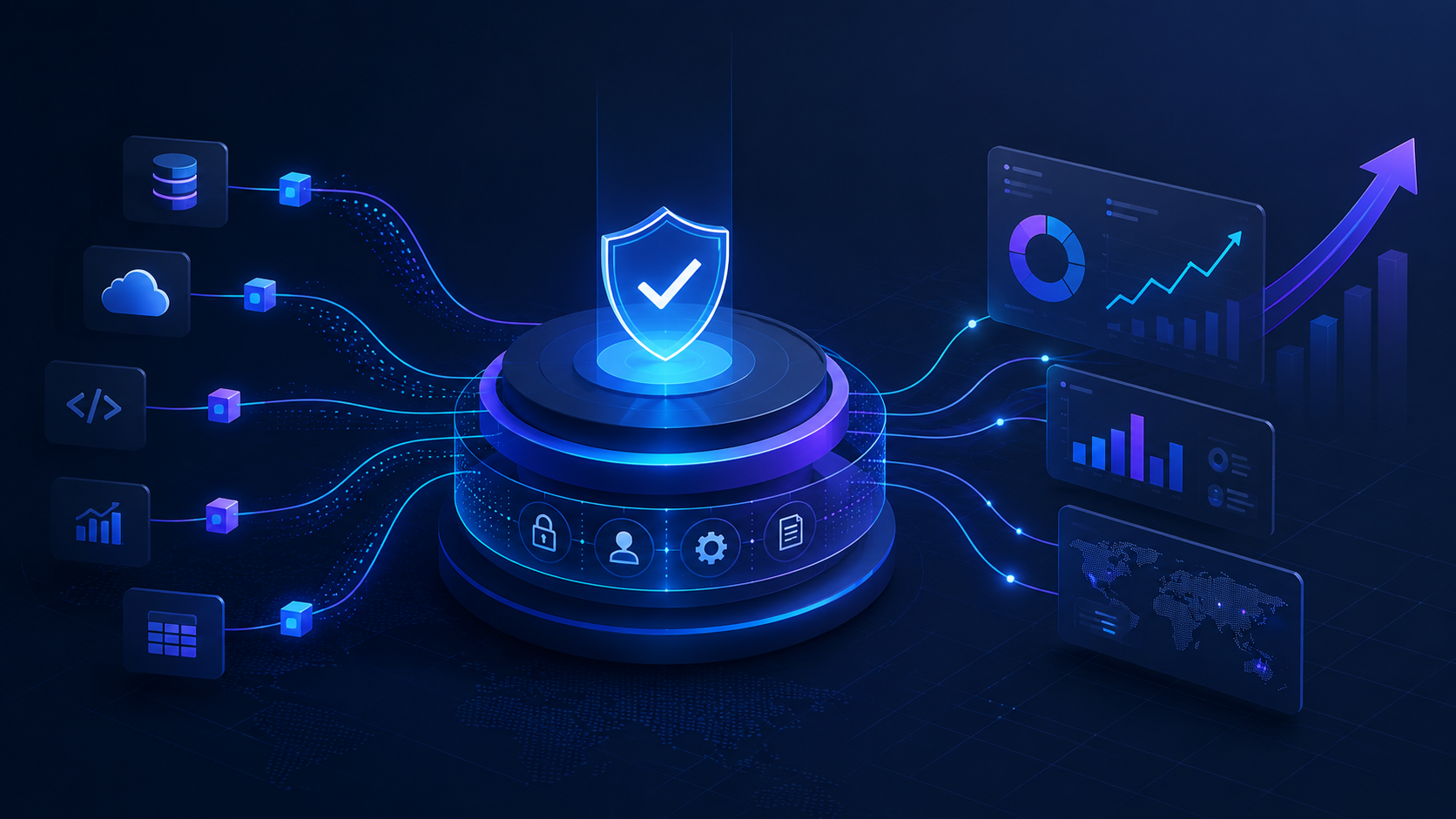
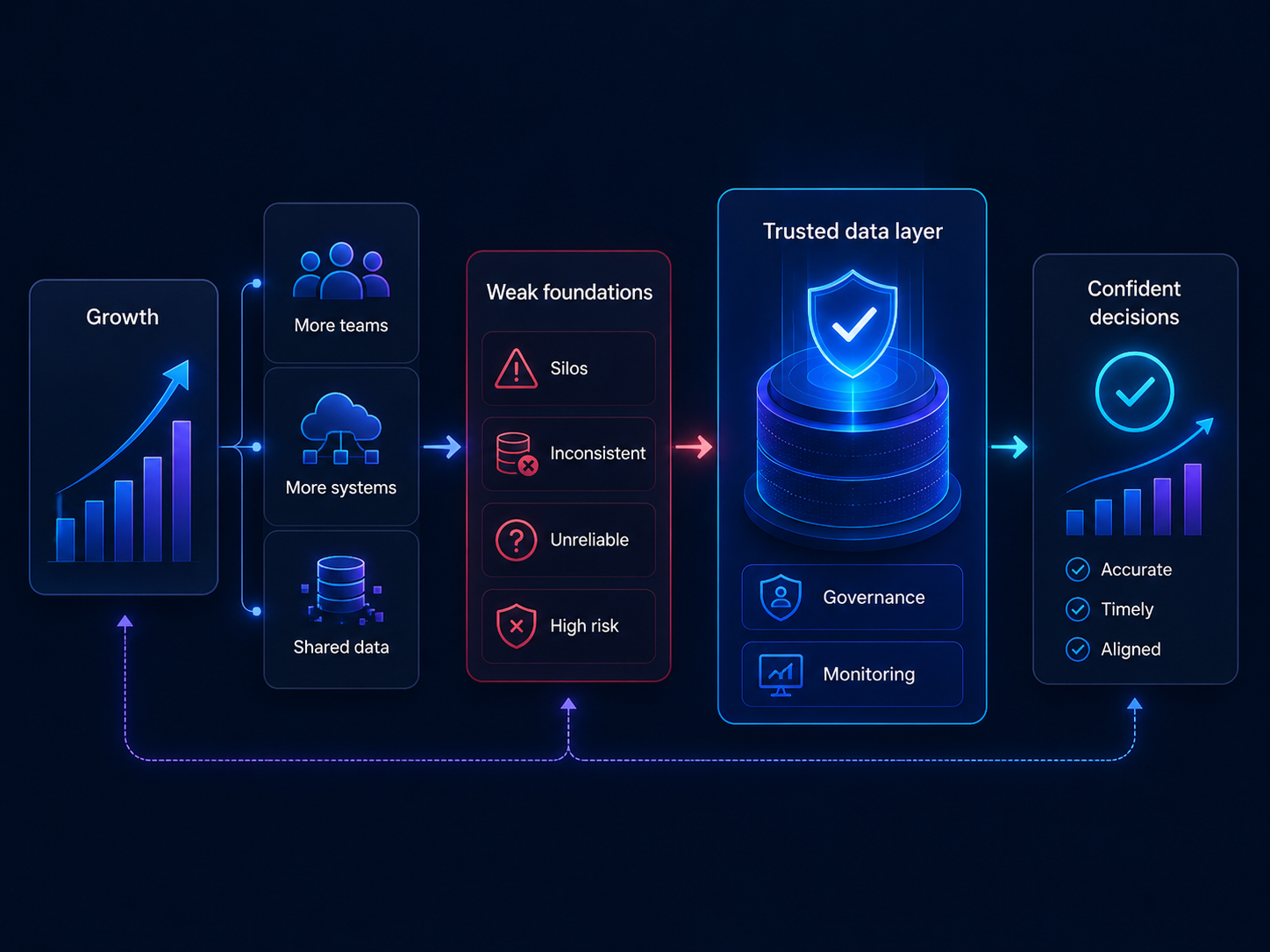
Growth creates more customers, teams, systems, reporting needs, revenue complexity, and operational pressure. It also exposes a weakness many companies underestimate: the fragility of their data foundations.
Core idea
In a small organization, a data issue can look harmless. A sales report is slightly inconsistent. A customer field is manually corrected. A finance number is checked twice before being shared. A dashboard needs a quick explanation from someone who knows the data.
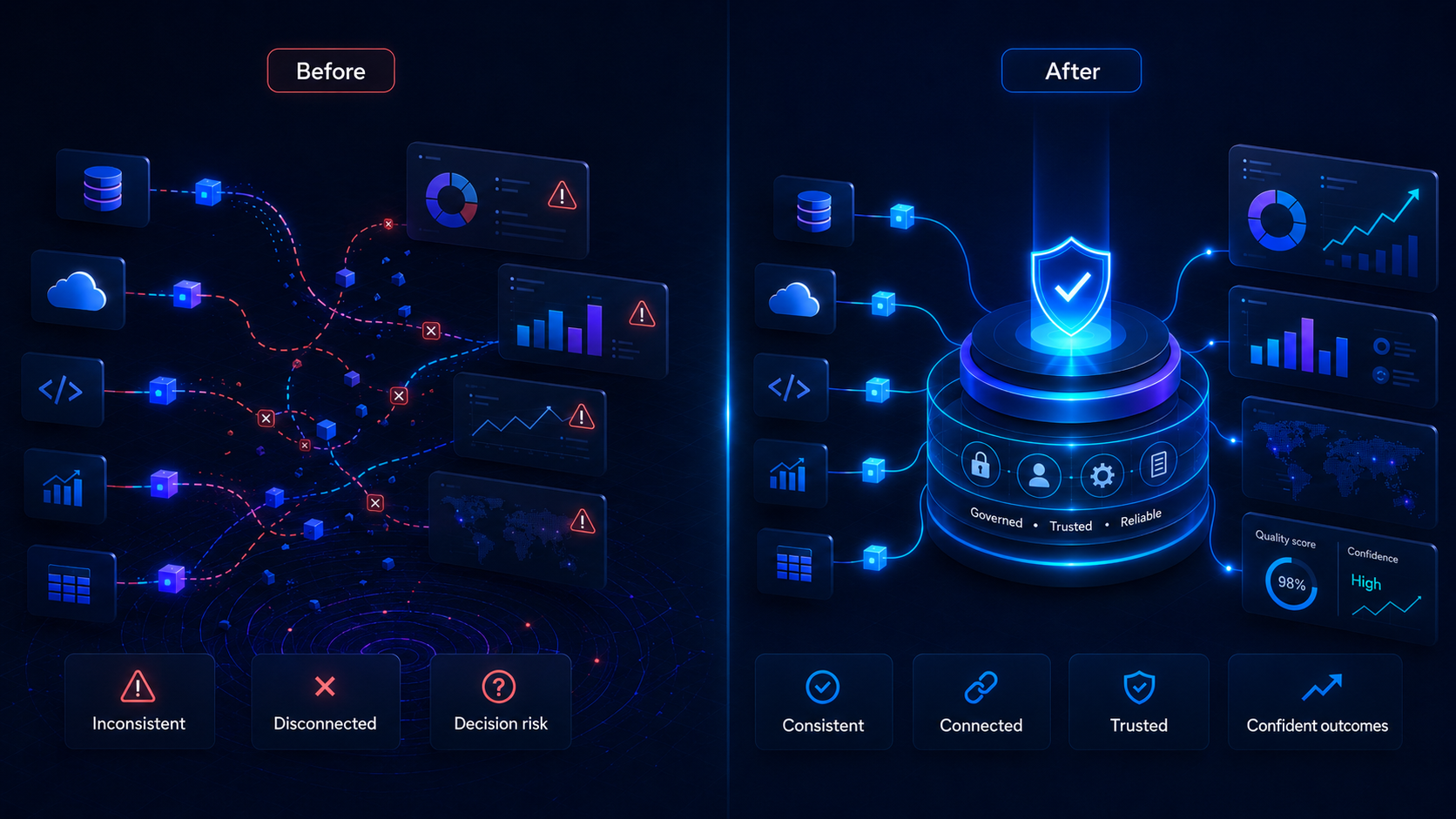
But as the business grows, these small issues multiply. What used to be a reporting inconvenience becomes an operational risk. What used to be a manual workaround becomes a bottleneck. What used to be a local data problem becomes a company-wide trust issue.
Scaling a business requires scaling data trust.
Why Data Trust Becomes Harder as the Business Grows
In the early stages of a company, data is often managed informally. A few people understand where the numbers come from, how reports are built, and which fields should be trusted. Knowledge lives in people's heads. Processes are flexible. Problems are solved manually.
This can work for a while.
But growth changes the equation. More teams start using the same data for different purposes. Sales uses customer data to manage pipeline. Marketing uses it for campaigns and attribution. Finance uses it for forecasting and revenue reporting. Operations uses it to monitor delivery and performance. Leadership uses it to make strategic decisions.
At the same time, the number of systems increases. CRM, ERP, billing tools, marketing automation platforms, data warehouses, BI dashboards, spreadsheets, internal applications, third-party APIs, and AI tools all start producing and consuming data.
The result is more complexity, more dependencies, and more opportunities for data to become inconsistent. A field that was once used by one team now supports multiple processes. A manual correction that was once acceptable now breaks an automated workflow. A dashboard that was once reviewed by a small team now influences executive decisions.
This is where weak data foundations become visible.
From Reporting Issue to Decision Risk
Many companies first notice data trust problems through reporting. Two dashboards show different revenue numbers. Customer counts do not match between the CRM and the data warehouse. Pipeline data is incomplete. Product usage metrics are delayed. Finance does not trust sales forecasts. Operations questions performance reports.
At first, these problems are treated as technical defects. But the real issue is deeper.
When data cannot be trusted, decision-making becomes fragile. Leaders spend more time debating the numbers than discussing the actions to take. Teams create their own versions of the truth. Analysts become data firefighters. Business users lose confidence in dashboards. Governance becomes reactive instead of proactive.
The cost is not only technical. It is organizational. Poor data trust creates friction between teams. Sales may blame marketing for poor lead quality. Finance may challenge sales pipeline accuracy. Operations may question customer segmentation. Leadership may delay decisions because the numbers are unclear.
In a growing business, this friction compounds.
What Data Trust Really Means
Data trust is often confused with data quality. Data quality is part of the equation, but it is not enough.
A dataset can be technically clean and still not be trusted.
For data to be trusted, users need to understand where it comes from, what it means, how fresh it is, who owns it, how it is controlled, and whether it is suitable for the decision they need to make.
True data trust exists when business users can rely on data without constantly asking, "Can we trust this number?"
Accuracy
Data correctly represents the business reality it is supposed to describe.
Completeness
Critical fields are present when they support reporting, automation, billing, compliance, or segmentation.
Consistency
The same business concept is defined and calculated the same way across teams and systems.
Timeliness
Data is available when decisions, workflows, and controls need it.
Ownership
Critical domains have clear business and technical owners who can resolve ambiguity.
Lineage
Teams understand how data moves from source systems to analytics, reporting, and operations.
Usability
Data is easy to interpret, access, and apply correctly.
Governance
Rules, responsibilities, and controls prevent data from degrading over time.
The Symptoms of Low Data Trust
A growing business usually shows clear symptoms when data trust is weak.
- Teams spend too much time reconciling numbers before meetings.
- Analysts repeatedly explain why dashboards do not match.
- Business users export data to spreadsheets because they do not trust official reports.
- Different teams use different definitions for the same metric.
- Executives discover data issues before the data team does.
- Reports require manual corrections before they can be shared.
- Data ownership is unclear, so nobody knows who should fix a broken field.
- New tools are added faster than data rules are defined.
Another common symptom is the rise of shadow reporting. When teams stop trusting official data products, they build their own. Sales creates its own spreadsheet. Finance builds a parallel revenue report. Marketing creates a separate attribution model. Operations tracks performance manually.
This may solve short-term frustration, but it creates long-term fragmentation. The business ends up with multiple versions of the truth, each optimized for one team but disconnected from the wider operating model.
Why Growth Exposes Weak Data Foundations
Growth increases data pressure in four main ways.
Volume
More customers, transactions, events, campaigns, products, and interactions make manual checks impossible.
Complexity
More tools, teams, exceptions, metrics, and dependencies create more opportunities for inconsistency.
Speed
Leadership expects timely visibility, while operational teams need alerts, segmentation, and forecasts faster.
Accountability
Data becomes part of governance, compliance, investor reporting, customer experience, and strategic planning.
A startup can survive with informal data practices. A growing business cannot. At scale, data trust must become a managed capability.
The Hidden Cost of Not Scaling Data Trust
The cost of poor data trust is often underestimated because it is spread across the organization. It appears as wasted time, duplicated work, delayed decisions, missed opportunities, poor customer experience, inaccurate forecasting, compliance exposure, and internal frustration.
If every weekly business review starts with a debate about whether the numbers are correct, the company is not only losing time. It is losing decision velocity. If sales pipeline data is incomplete, revenue forecasting becomes unreliable. If customer master data is inconsistent, marketing campaigns target the wrong segments. If product usage data is delayed or inaccurate, customer success teams miss churn signals.
The most dangerous part is that people adapt to poor data. They build workarounds. They stop using dashboards. They rely on intuition. They ask specific people for explanations. They duplicate reports.
Over time, the organization accepts data distrust as normal. That is when data stops being a strategic asset and becomes an operational liability.
Scaling Data Trust Requires More Than Better Tools
Many companies respond to data trust problems by buying more tools. They add a data catalog, a data quality platform, a BI tool, a governance solution, or a modern data stack component. These tools can help, but they do not solve the problem alone.
Data trust is not created by tools. It is created by a system. That system includes people, processes, rules, ownership, architecture, monitoring, and culture.
A data quality tool can detect anomalies, but someone must define what quality means. A catalog can document datasets, but someone must maintain business definitions. A dashboard can show metrics, but someone must ensure the logic is aligned. A data warehouse can centralize information, but someone must govern how data is modeled and consumed.
Technology is an accelerator. It is not a substitute for governance and accountability.
The Foundation: Clear Business Definitions
One of the most common reasons data trust breaks down is unclear definitions. What is an active customer? What is revenue? What is churn? What is a qualified lead? What is a closed opportunity? What is a delivered order? What is a valid transaction? What is a compliant supplier? What is a high-risk account?
These questions seem simple until different teams answer them differently.
Sales may define a customer as an account with an open opportunity. Finance may define a customer as an account with paid invoices. Customer success may define a customer as an account currently using the product. Marketing may define a customer as anyone who converted from a campaign.
None of these definitions is necessarily wrong. But if they are not explicitly managed, they create confusion. Scaling data trust starts with defining critical business concepts.
The goal is not to document everything. The goal is to identify the concepts that matter most for decision-making and operational execution. These definitions should be owned by the business, supported by data teams, and implemented consistently across systems and reports.
Data Ownership Is Not Optional
In small organizations, ownership is often informal. People know who to ask when something is wrong. At scale, informal ownership fails.
Every critical data domain needs clear owners. Customer data, product data, supplier data, employee data, transaction data, financial data, and operational data should not be nobody's responsibility.
Ownership should exist at two levels. Business ownership defines meaning, rules, priorities, and acceptable usage. Technical ownership ensures pipelines, models, controls, access, and reliability.
For example, the sales operations team may own the business rules for opportunity data, while the data engineering team owns the pipeline that moves opportunity data into the warehouse.
Without ownership, data issues become circular. The business blames IT. IT asks for clearer rules. Analysts patch reports. Leadership waits for answers. Clear ownership turns data trust from a reactive support activity into a shared responsibility.
Build a Trusted Data Layer
As companies grow, data often becomes scattered across tools and reports. Each team builds its own logic. Metrics are calculated differently. Data transformations are duplicated. Source system complexity leaks into dashboards.
To scale trust, the business needs a trusted data layer.
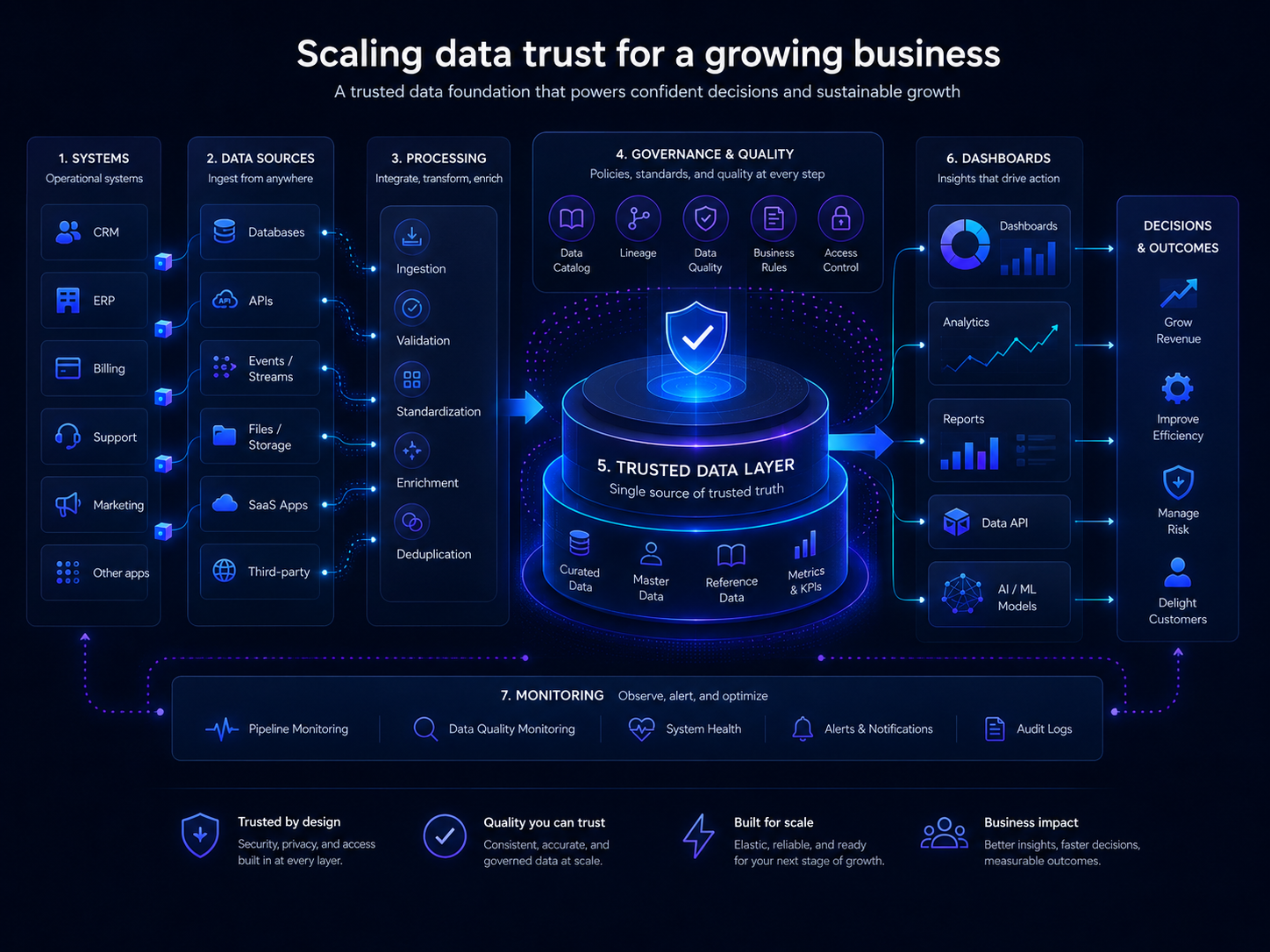
This layer acts as the controlled foundation between raw systems and business consumption. It standardizes definitions, applies quality rules, manages transformations, and exposes reliable data products for analytics, reporting, automation, and AI.
A trusted data layer does not mean creating a rigid centralized bottleneck. It means creating a reliable operating layer where important data is modeled, documented, validated, and governed.
This layer should include clean domain models, standard metric definitions, master data, reference data, quality controls, lineage, access rules, and monitoring.
Without this layer, every dashboard becomes a new interpretation of reality. With it, teams can build faster because they are not starting from raw, inconsistent data each time.
Data Quality Rules Must Be Explicit
Many data quality expectations are implicit. People expect customer emails to be valid. They expect revenue to be positive. They expect opportunities to have close dates. They expect invoices to be linked to customers. They expect product IDs to match a reference table. They expect required fields to be filled.
But unless these expectations are translated into explicit rules, they cannot be monitored reliably. Data quality rules should be defined for critical data elements.
A customer must have a unique identifier.
A closed opportunity must have a close date.
An invoice must be linked to a valid customer account.
A transaction amount cannot be negative unless it is a refund.
A country code must match an approved reference list.
A product category cannot be empty for active products.
A lead marked as qualified must have a source, owner, and qualification date.
A supplier must have a valid legal entity identifier before payment.
These rules should not live only in documentation. They should be implemented as automated controls. The business should know which rules exist, which datasets they protect, who owns them, and what happens when they fail.
Monitoring Data Trust Continuously
Data trust cannot rely on occasional manual reviews. As the business scales, data must be monitored continuously.
Monitoring should cover data freshness, completeness, validity, consistency, duplicates, schema changes, pipeline failures, unexpected volume changes, and business anomalies.
If yesterday's CRM pipeline extract contains 40% fewer opportunities than usual, the team should know before the executive dashboard is refreshed. If a source system changes a field format, the data team should detect it before downstream reports break. If customer records are duplicated, the issue should be flagged before billing, marketing, or support workflows are affected.
Monitoring turns data quality from a reactive activity into an operational discipline. The goal is not to eliminate every issue. That is unrealistic. The goal is to detect important issues early, understand their impact, and resolve them before they damage decisions.
Prioritize Critical Data, Not All Data
One mistake growing companies make is trying to govern everything at once. This usually fails.
Not all data deserves the same level of control. Some datasets are exploratory. Some are temporary. Some are low impact. Others are business critical.
Scaling data trust requires prioritization. The company should identify its critical data domains, critical reports, critical metrics, and critical processes.
A useful question is: if this data is wrong, what decision, process, or customer experience breaks?
Data that supports revenue reporting, financial forecasting, customer operations, regulatory obligations, executive dashboards, pricing, billing, or strategic decisions should receive stronger controls. Less critical data can have lighter governance. This risk-based approach makes data trust practical.
Align Data Governance With Business Processes
Data governance often fails when it is disconnected from real business processes. If governance is seen as documentation, meetings, or compliance paperwork, teams will avoid it.
Effective governance is operational. It should be embedded into how data is created, updated, validated, consumed, and corrected.
If sales pipeline quality is poor, the solution is not only to fix the dashboard. The company must look at how opportunities are created, which fields are mandatory, who validates them, how stage changes are controlled, and how exceptions are handled.
If customer data is inconsistent, the solution is not only deduplication. The company must define account creation rules, ownership, matching logic, merge processes, and source-of-truth principles.
Governance should not sit outside the business. It should improve how the business operates.
Create Feedback Loops Between Business and Data Teams
Data trust improves when business users and data teams work together. Business users understand context, exceptions, and operational reality. Data teams understand systems, models, pipelines, and controls.
If these groups are disconnected, trust breaks down. Business teams may complain that dashboards are wrong without explaining the underlying process issue. Data teams may build technically correct models that do not reflect how the business actually works.
A strong data trust model creates feedback loops. When users find data issues, they should have a clear way to report them. Issues should be categorized, prioritized, assigned, and tracked. Root causes should be analyzed. Fixes should be communicated. Repeated issues should lead to better rules or process changes.
This is how a company moves from fixing symptoms to improving the system.
Make Data Lineage Visible
As data flows through more systems, people need to understand where it comes from and how it changes. Lineage helps answer questions such as where a metric comes from, which source system feeds a dashboard, which transformations are applied, which reports will be impacted if a field changes, why a number changed compared to last week, and which team owns the data.
Without lineage, troubleshooting becomes slow and risky. Every investigation requires manual digging. Teams hesitate to change pipelines because they do not know what will break.
Lineage does not need to be perfect from day one. Start with critical reports, key data products, and high-impact pipelines. The goal is to make dependencies visible enough to manage change safely.
Standardize Metrics and Reporting Logic
A growing company needs consistent metrics. If each team calculates metrics differently, leadership cannot manage the business effectively.
Metric standardization means defining key performance indicators clearly and implementing them consistently. Revenue, gross margin, churn, customer acquisition cost, lifetime value, active users, conversion rate, pipeline coverage, forecast accuracy, and retention should have documented definitions and controlled calculation logic.
These metrics should not be re-created manually in every dashboard. A semantic layer, metrics layer, governed BI model, or shared transformation layer can help ensure that teams consume consistent logic. The more important the metric, the more controlled its definition should be.
Data Trust and AI Readiness
As companies adopt AI, data trust becomes even more important. AI systems depend on reliable inputs. If customer data is duplicated, product data is incomplete, or historical records are inconsistent, AI outputs become unreliable.
Poor data quality does not only affect dashboards. It affects recommendations, predictions, automation, personalization, search, copilots, and decision support systems.
A growing business cannot build serious AI capabilities on weak data foundations. Before scaling AI, companies need to strengthen data governance, metadata, lineage, access control, data quality, master data, and monitoring.
AI increases the value of trusted data, but it also increases the risk of using untrusted data.
The Role of Master Data and Reference Data
Many trust problems come from unstable master data and reference data. Customer names differ across systems. Product categories are inconsistent. Supplier records are duplicated. Country codes are not standardized. Business units use different hierarchies. Account ownership changes without being reflected everywhere.
These issues may seem basic, but they affect reporting, automation, compliance, and customer experience.
Master data management helps create consistent core entities such as customers, suppliers, products, employees, assets, and locations. Reference data management ensures that controlled lists, codes, classifications, and hierarchies are consistent across systems.
For a growing business, master data and reference data are not administrative details. They are structural foundations. Without them, every new system adds more fragmentation.
Data Trust Requires Change Management
Data trust is also a human challenge. People are used to their own spreadsheets, reports, definitions, and habits. When a company introduces standard definitions, ownership, quality rules, and governance processes, some teams may see it as control or bureaucracy.
This is why change management matters. Teams need to understand why data trust matters, how it helps them, and what role they play in improving it.
The message should not be: "We are adding governance because data is messy." The message should be: "We are making data easier to trust so teams can make faster decisions, reduce manual work, and operate with more confidence."
Data governance should be positioned as an enabler, not a constraint.
Practical Steps to Scale Data Trust
A growing business can start scaling data trust through a structured approach.
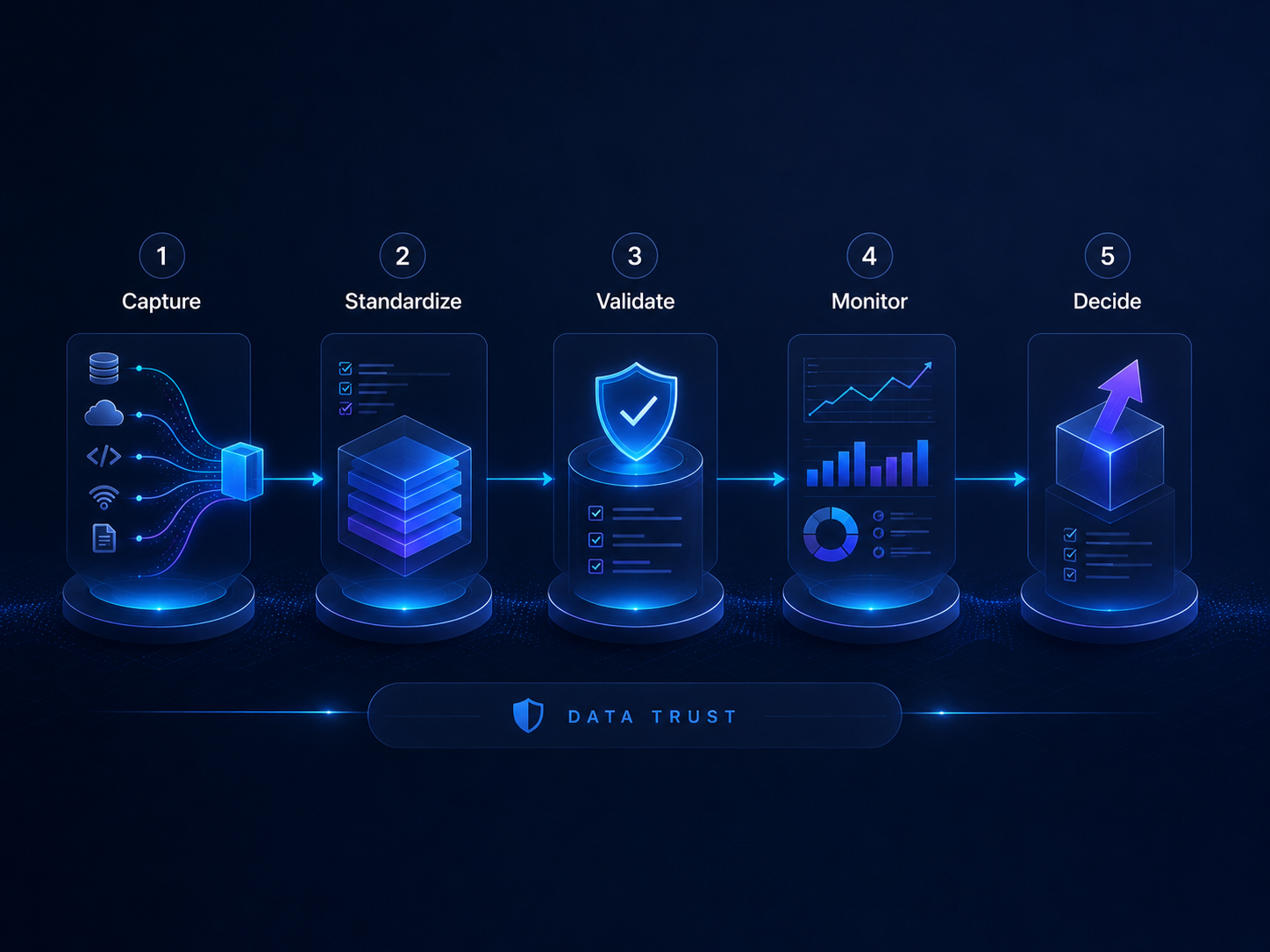
- 1Identify the most critical business decisions and processes that depend on data.
- 2Map the key data domains that support those decisions, such as customers, revenue, products, suppliers, pipeline, transactions, operations, or finance.
- 3Define the most important business concepts and metrics so teams agree on their meaning.
- 4Assign business and technical ownership for critical data domains.
- 5Create quality rules for critical data elements, starting with simple rules that catch high-impact issues.
- 6Implement automated monitoring for freshness, completeness, validity, consistency, duplicates, and anomalies.
- 7Create a trusted data layer where key data is cleaned, standardized, modeled, and governed.
- 8Document lineage for critical reports and high-impact pipelines.
- 9Create a clear process for reporting, prioritizing, resolving, and communicating data issues.
- 10Review data trust regularly with business and technical stakeholders.
The objective is not to build a perfect system immediately. The objective is to create a repeatable operating model that improves over time.
What Good Looks Like
A company that scales data trust well behaves differently.
Business users know which dashboards are official.
Key metrics have clear definitions.
Data owners are identified.
Critical quality rules are monitored.
Issues are detected before they reach executive reporting.
Teams understand where data comes from.
Changes to source systems are managed carefully.
Data problems are tracked and resolved systematically.
Analysts spend less time reconciling numbers and more time generating insight.
Leadership discussions focus on decisions, not data disputes.
Most importantly, people use data with confidence. They may still ask questions. They may still challenge assumptions. But they do not constantly doubt whether the data foundation itself is reliable.
That is the real value of data trust.
Data Trust Is a Scaling Capability
Many companies invest heavily in growth: sales, marketing, products, operations, hiring, systems, and expansion. But they often underinvest in the data foundation that supports that growth.
This creates a dangerous gap. The business becomes bigger, but its data practices remain informal. More decisions depend on data, but the data is not governed. More teams consume reports, but definitions are inconsistent. More systems are connected, but ownership is unclear. More automation is introduced, but quality controls are weak.
Eventually, growth amplifies the weaknesses. Scaling data trust means building the discipline, architecture, and operating model required for reliable decision-making at scale.
It is not a one-time project. It is a continuous capability.
Conclusion
Growth Exposes Weak Data Foundations
In a small company, data issues can be managed through manual checks, personal knowledge, and informal coordination. But as more teams, systems, and processes depend on the same data, those weaknesses become decision risks.
A growing business needs more than dashboards. It needs trusted data foundations: clear definitions, strong ownership, automated quality controls, visible lineage, standardized metrics, reliable master data, continuous monitoring, and governance embedded into business processes.
Data trust is not about perfection. It is about confidence that the numbers are reliable, that teams are aligned, that decisions are based on shared facts, and that growth is supported by a data foundation strong enough to scale.
Businesses that invest in data trust early move faster, operate better, and make decisions with greater clarity. Businesses that ignore it eventually pay the price through confusion, friction, and poor decisions.
In a growing company, data trust is not a technical luxury. It is a business necessity.
Next step
Identify where data trust is slowing your business down.
A focused data audit can reveal the definitions, ownership gaps, quality rules, and monitoring checks that matter most for your growth stage.
Book a data audit